Dive or Snorkel at Manta Point Komodo: A Definitive Guide to Karang Makassar
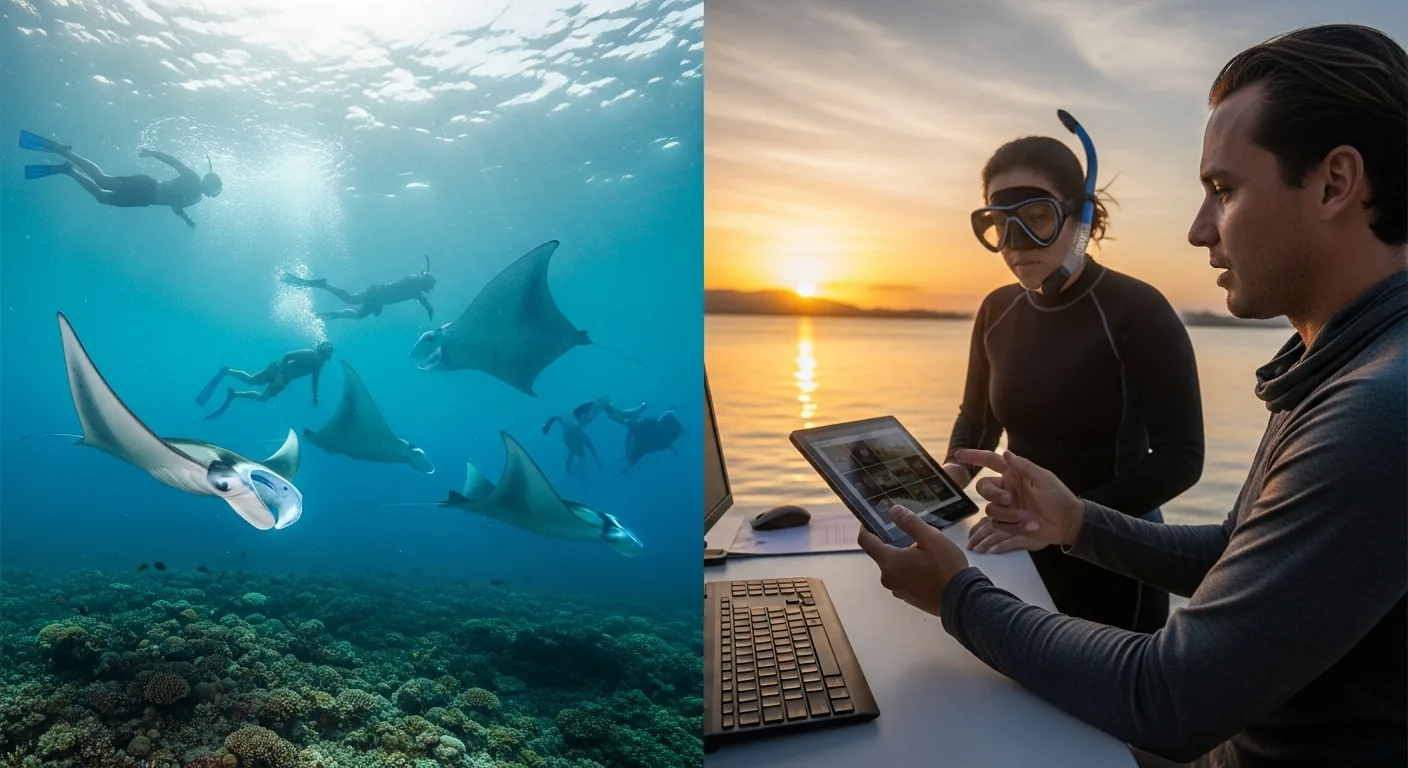
The water moves with purpose. It is not an aggressive force, but a constant, confident pressure against your body—a river within the sea. Below, the seabed is a pale expanse of rubble and coral fragments, a seemingly spartan landscape scrolling past. Then, a shadow detaches from the periphery. It is not dark, but a shifting, graceful eclipse of the light from above. A second follows, then a third. Soon, the water is filled with them: giant reef mantas, Mobula alfredi, with wingspans of four meters, soaring effortlessly in the current. They glide in formation, mouths agape to filter the plankton-rich waters of the Linta Strait. This is the silent, moving spectacle of Karang Makassar, the site known globally as Manta Point Komodo. The question is not whether to witness it, but how.
Choosing between a Komodo manta dive and a Komodo manta snorkel experience is a primary consideration for any visitor to Komodo National Park. Each offers a distinct perspective on this profound marine encounter. One places you directly within their aquatic ballroom, a fellow participant in the current. The other provides a grand, overhead view of the choreography, an observer in the royal box. This guide details the nuances of both experiences, providing the specific information required to select the engagement best suited to your skill, comfort, and photographic ambitions at this singular location. See also: makassar drift dive.
The Karang Makassar Enigma: Anatomy of Komodo’s Manta Aggregation Site
Karang Makassar is not a conventional dive site. It lacks the dramatic walls or vibrant coral gardens found elsewhere within the 1,733 square-kilometer Komodo National Park. Instead, it is a vast, submerged plateau, a channel of coral rubble and sand stretching for over two kilometers. Its strategic position between Komodo and Rinca islands funnels the powerful currents of the Indonesian Throughflow, creating a nutrient-rich expressway that attracts dense concentrations of zooplankton. This is the primary draw for the manta rays. See also: this photography tips komodo.
The site’s bathymetry is key to its dual-access appeal. With an average depth of 8 to 15 meters, the action is well within the reach of both snorkelers and certified divers. The currents, which can range from a gentle 1 knot to a formidable 4 knots, dictate the nature of the visit. This is almost always a drift experience; the boat drops you at an up-current point, and you are carried across the feeding ground. For divers, this means a passive, low-exertion flight. For snorkelers, it is a brisk float, following the action from the surface. The visibility, typically 15 to 25 meters, is generally sufficient to observe the mantas from either vantage point. The key difference lies in proximity and perspective. A Komodo manta dive allows you to hover just meters above the seabed, watching as the rays glide directly overhead, while a Komodo manta snorkel offers a wider, panoramic view of the entire congregation. See also: Contact pricing.
The Submerged Ballet: A Komodo Manta Dive Experience
To descend into Karang Makassar is to enter another state of being. The transition from the boat’s gentle rocking to the silent, determined push of the current is immediate. Your dive guide signals the group to deflate their BCDs, and you sink into the blue, orienting yourself to the direction of the drift. The experience is one of controlled surrender. There is no need to kick; the current is your propulsion. The primary skill is buoyancy control, maintaining a neutral position a few meters above the rubble to avoid disturbing the fragile ecosystem or the mantas themselves. See also: Manta Point Komodo Home.
The reward for this discipline is an intimate encounter. At depth, you are on their level. A manta ray may approach from the front, its cephalic fins curled, passing so closely you can see the unique spot pattern on its ventral side—a pattern as individual as a human fingerprint. You may find a “cleaning station,” a small coral bommie where cleaner wrasse and other small fish perform essential grooming services for the patient giants. The Komodo manta dive experience is about these close, personal observations. It is about noticing the remoras clinging to a manta’s back, the gentle flare of its gills, and the intelligence in its eye. Photographers, in particular, will find the dive perspective advantageous for capturing upward-angle shots of the mantas against the sunlit surface. Due to the currents, an Advanced Open Water Diver certification is recommended, and operators often require a minimum of 30 logged dives.
An Aerial Perspective: The Komodo Manta Snorkel at Karang Makassar
The Komodo manta snorkel offers an entirely different, though no less compelling, experience. From the surface, Karang Makassar reveals its scale. You can see dozens of mantas at once, a squadron of dark shapes moving in concert over the pale seabed. The experience is less about intimate detail and more about appreciating the grand pattern of this natural phenomenon. With fins, mask, and snorkel, you float along with the current, your guide leading the way, pointing out the densest concentrations of activity below.
Because the site is so shallow, the mantas are often only 5 to 10 meters from the surface. When they ascend to feed near the top of the water column, a snorkeler can find themselves mere feet from a five-meter wingspan. This accessibility is the primary advantage of the Komodo manta snorkel. It requires no certification and minimal equipment, opening the experience to a broader audience, including families and less experienced swimmers (though comfort in moving water is essential). The physical exertion is higher than diving, as you are actively swimming to keep pace and position yourself, but the freedom of movement is greater. You can cover more ground and follow a specific group of mantas as they traverse the plateau. It is a dynamic and exhilarating way to witness the spectacle from above.
Dive vs. Snorkel at Manta Point Komodo: A Comparative Analysis
The decision to dive or snorkel at Karang Makassar depends entirely on your personal preferences, certification level, and what you hope to gain from the encounter. Both methods provide an exceptional opportunity to observe one of the ocean’s most charismatic megafauna in a prime natural habitat. Below is a direct comparison to aid in your planning.
| Feature | Komodo Manta Dive | Komodo Manta Snorkel |
|---|---|---|
| Perspective | Immersive, eye-level view. Allows for observation of cleaning stations and ventral patterns from below. | Panoramic, top-down view. Allows for observation of group behavior and the full scale of the aggregation. |
| Proximity | Potentially very close encounters as mantas pass directly overhead. A more intimate feeling. | Close encounters are possible when mantas feed near the surface, but generally a more distant view. |
| Required Certification | PADI Open Water required, Advanced Open Water strongly recommended. Minimum logged dives may apply. | None. Suitable for all ages, but requires confidence swimming in open water with currents. |
| Physical Exertion | Low. The dive is a passive drift, with primary effort focused on buoyancy control. | Moderate to high. Involves active swimming and finning to keep pace with the current and the boat. |
| Equipment | Full scuba gear: BCD, regulator, tank, weights, computer. A reef hook may be used. | Mask, snorkel, fins. A wetsuit or rash guard is recommended for sun and jellyfish protection. |
| Photography | Excellent for upward-angle shots, detailed portraits, and capturing cleaning behavior. Requires underwater housing. | Good for capturing the scale of the manta train and split-level shots. Less detail and more challenging with water movement. |
Your Komodo Day Trip: Itinerary, Inclusions & Pricing
A day trip to Manta Point Komodo from Labuan Bajo is a full and rewarding experience, typically incorporating at least one other notable site. Our expeditions are structured for comfort, safety, and maximum time in the water.
Sample Itinerary
- 7:00 AM – 7:30 AM: Hotel transfer to the Labuan Bajo harbor.
- 7:45 AM: Boat departure, safety briefing, and equipment preparation. Coffee and light breakfast served.
- 9:30 AM: Arrival at Karang Makassar (Manta Point). First session: Komodo manta dive or snorkel.
- 11:00 AM: Surface interval. Fresh fruit and refreshments are provided while transiting to the next site.
- 12:30 PM: Second site visit, often the calm, clear waters of Manjarite Komodo for a relaxed snorkel or dive, or a stop at Taka Makassar.
- 1:45 PM: Lunch served on board—a freshly prepared Indonesian meal.
- 2:45 PM: Begin the return journey to Labuan Bajo.
- 4:30 PM – 5:00 PM: Arrival at Labuan Bajo harbor and transfer back to your hotel.
What Is Included
- Round-trip hotel transfers in the Labuan Bajo area.
- Full-day speedboat charter with an experienced captain and crew.
- Two guided sessions in the water (dive or snorkel).
- Professional, PADI-certified divemaster or snorkel guide (4:1 guest-to-guide ratio for divers).
- All necessary dive or snorkel equipment.
- Onboard lunch, snacks, fresh fruit, mineral water, coffee, and tea.
Please note that the Komodo National Park entrance and conservation fees (approximately IDR 275,000 – IDR 400,000 per person, subject to change) are typically paid separately on the day of the trip.
Expedition Pricing
Our small-group trips are designed to provide a premium and uncrowded experience. Pricing is structured to reflect the quality of our guides, equipment, and service.
- Komodo Manta Snorkel Day Trip: From $135 USD per person.
- Komodo Manta Dive Day Trip (2 Dives): From $185 USD per person.
Private charter options are available upon request for a fully customized itinerary. Contact us for detailed pricing and availability.
Beyond the Mantas: The Clear Waters of Manjarite Komodo
While Karang Makassar is the centerpiece, a well-rounded day trip showcases the diversity of Komodo’s marine environments. A frequent second stop is Manjarite, a small island near Flores. Manjarite Komodo offers a complete contrast to the dynamic currents of Manta Point. Here, the water is exceptionally calm and clear, protected from the main channel flows. A long wooden jetty extends over a shallow reef, creating a perfect environment for a relaxed snorkel or a shallow second dive.
The focus at Manjarite Komodo shifts from megafauna to macro life and vibrant corals. The pilings of the jetty are encrusted with soft corals and sponges, providing habitat for juvenile fish, nudibranchs, and schools of damselfish. Snorkelers can explore the gentle slope directly from the boat, while divers can spend time searching for cryptic creatures like frogfish and ghost pipefish. It is an ideal location for underwater photography and for appreciating the delicate beauty of a healthy coral reef system, serving as a tranquil counterpoint to the morning’s high-energy manta encounter.
Frequently Asked Questions: Planning Your Manta Encounter
When is the best time of year to visit Manta Point Komodo?
The prime season for manta ray sightings in Komodo is during the dry season, from April to December. Within this period, the months of June through September often offer the best combination of calm surface conditions and high manta numbers. Water temperatures typically range from 25°C to 29°C (77°F to 84°F).
Are manta ray sightings guaranteed at Karang Makassar?
While Karang Makassar is one of the most reliable manta aggregation sites on the planet, these are wild animals in their natural habitat. Sightings are not 100% guaranteed. However, the probability is extremely high, especially during the peak season. Our experienced guides use their knowledge of tides and currents to maximize the chances of a successful encounter.
What is a manta “cleaning station”?
A cleaning station is a specific coral head or bommie where manta rays and other large marine animals gather to have parasites and dead skin removed by smaller fish, such as cleaner wrasse. It is a vital symbiotic relationship. Observing this behavior is a highlight of a Komodo manta dive, as the mantas will often hover patiently for long periods.
How strong are the currents at Manta Point?
The currents are the defining feature of Karang Makassar and are not to be underestimated. They can range from mild to very strong (over 4 knots). All our trips are planned around the tide charts to ensure conditions are safe and appropriate for a drift dive or snorkel. Your guide will provide a thorough briefing on current procedures before you enter the water.
What is the Komodo National Park fee and is it included?
The Komodo National Park fee is a mandatory charge for all visitors, contributing to the conservation and management of this UNESCO World Heritage Site, which was established in 1980. The fee structure can be complex and is subject to change by the park authorities. It is typically not included in the trip price and must be paid in cash (Indonesian Rupiah) on the day of your tour.
Our Commitment to Komodo’s Marine Biosphere
Manta Point Komodo is more than a tour operator; we are stewards of the environment we operate in. Our philosophy is rooted in responsible marine tourism that prioritizes the health of the ecosystem and the welfare of its inhabitants. We adhere strictly to the guidelines set by the Komodo National Park authority and international best practices for marine megafauna interaction. Our groups are intentionally small, with a maximum ratio of four divers to one PADI-certified Divemaster, ensuring personalized attention and minimal impact on the environment.
Our guides are not just navigators; they are trained marine naturalists who provide educational briefings on manta ray biology, behavior, and the conservation challenges they face. We practice passive interaction, meaning we observe the mantas without touching, chasing, or altering their natural behavior. By choosing to explore Karang Makassar with us, you are supporting a sustainable model that helps protect this critical habitat for generations to come.
Reserve Your Place: The Manta Point Komodo Booking Process
Securing your day trip to encounter the mantas of Karang Makassar is a straightforward process. We recommend booking in advance, particularly during the peak season from June to September, as our small-group trips have limited capacity.
- Initial Inquiry: Contact our booking office via email at bd@juaraholding.com or by phone/WhatsApp at +62 811-3941-4563. Please specify your desired date, the number of participants, and whether you are interested in the Komodo manta dive or snorkel option.
- Consultation & Confirmation: Our team will respond within 24 hours with availability and a detailed proposal. We will confirm your diving certification level and any dietary requirements at this stage.
- Payment: To confirm your reservation, we require a deposit, which can be made via a secure online payment link. The remaining balance is due prior to the trip departure.
- Pre-Trip Information: Once confirmed, you will receive a comprehensive information package, including your hotel pickup time, a list of what to bring, and details about the Komodo National Park fees.
- The Expedition: On the day of your trip, our team will manage all logistics, allowing you to focus completely on the extraordinary marine environment of Komodo.