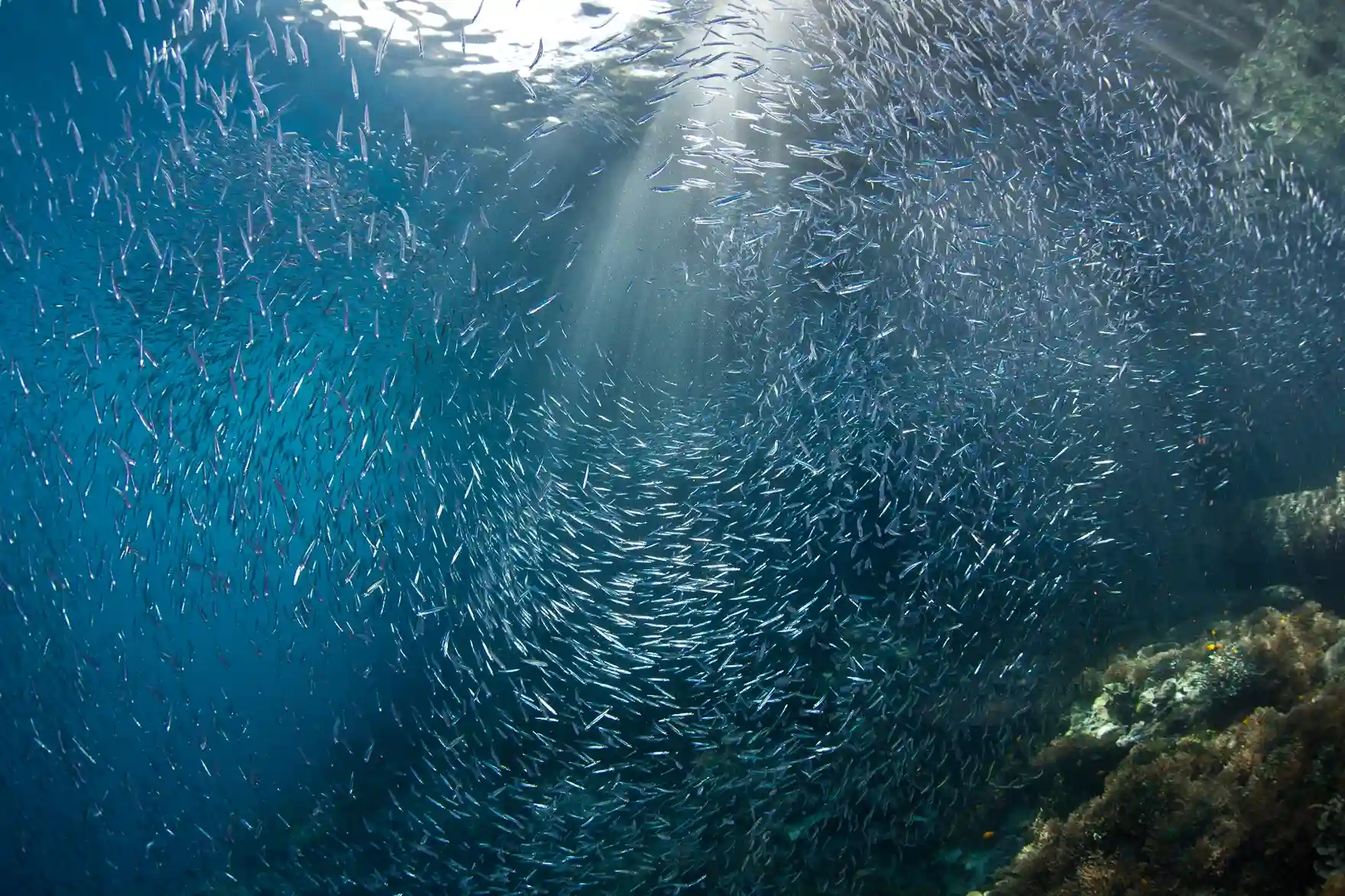
Operator-reported ranges for Manta Point: wet season (Dec-Mar) water around 27-29°C with visibility roughly 10-20 m, sometimes dropping into single digits during plankton blooms; dry season (Apr-Nov) water around 25-28°C, coolest at 25-27°C in Jul-Aug, with visibility more often 15-30 m and clearest in Jul-Aug. These are dive-operator figures, not a scientific dataset — no independent measured dataset for this exact site was found.
Why these numbers come from operators, not a scientific instrument
No public scientific oceanographic dataset publishes site-specific water temperature or visibility figures for Manta Point / Karang Makassar. What exists is a consistent, cross-checked pattern reported by multiple named Komodo dive and liveaboard operators, based on their crews’ day-to-day experience on the water. We report these as operator-reported ranges rather than presenting them as measured scientific data, and we cite the specific operators behind each figure so you can judge the sourcing yourself rather than trusting an unattributed number.
Water temperature by season
| Season | Typical range | Source |
|---|---|---|
| Wet season (Dec-Mar) | ~27-29°C typical; the warmest water of the year at this site | Labuan Bajo Diving season guide; Komodo Resort dive-site page |
| Dry season (Apr-Nov) | ~25-28°C typical; coolest around 25-27°C in Jul-Aug, when upwelling from south Komodo pushes cooler water north | Komodo Resort manta guide; Labuan Bajo Diving season guide |
Sources broadly agree on the shape of the pattern (wet season slightly warmer and more variable due to upwelling and plankton blooms; dry season generally similar or slightly cooler at its coolest point) even where exact degree figures differ by a point or two between operators.
Visibility by season
| Season | Typical range | Source |
|---|---|---|
| Wet season (Dec-Mar) | ~10-20 m typical; can drop to 8 m or below during heavy plankton blooms | Labuan Bajo Diving season guide; Komodo Resort diving blog |
| Dry season (Apr-Nov) | ~15-30 m typical; clearest at the upper end of that range in Jul-Aug | Labuan Bajo Diving season guide; Komodo Resort dive-site page |
There is a genuine trade-off worth understanding here: the same plankton blooms that reduce visibility in the wet season are what draw larger numbers of feeding mantas to the site. A wet-season trip with lower visibility is often the same trip with the best odds of a big manta encounter — the two are not independent variables you can optimise separately.
Why visibility and manta numbers move together
Mantas at Manta Point are filter feeders, and the plankton blooms that cloud the water are the food source drawing them in. This means a diver or snorkeler hoping for both maximum visibility and maximum manta activity on the same day is asking for two things that partly work against each other seasonally. If your priority is photography requiring clear water, the dry season’s better average visibility may suit you better even at slightly lower manta-sighting odds. If your priority is the largest possible manta encounter, the wet season’s plankton-rich, lower-visibility water is where the numbers say to go. See our Manta Point photography guide for how this trade-off affects shooting conditions specifically.
Current strength and how it relates to conditions
Current at Manta Point is tide-dependent rather than tied to season in a simple way, and is usually graded mild-to-moderate by Komodo operators — distinctly gentler than north-Komodo’s strong-current sites like Castle Rock or Crystal Rock. A guide will time your entry against the tide table for the day rather than a fixed clock time, which is one reason the “best time of day” for a dive or snorkel at this site is set by your guide’s read of conditions, not a universal rule that applies every day.
Planning your trip dates around these ranges
If you want the statistically best odds of larger manta groups and are comfortable with lower visibility and slightly stronger plankton-driven current, plan for December-March. If clearer water and a marginally calmer visual experience matter more than maximising group size, the broader dry season (April-November), and particularly the July-August peak-clarity window some operators report, is the better target. Either choice still involves wild animals and variable natural conditions — no operator can guarantee a specific temperature, visibility figure, or sighting on any single day regardless of season.
What this means for what you wear in the water
Even at the warmer end of the reported ranges, most snorkelers and divers wear at least a rash guard or thin wetsuit shorty at Manta Point — not primarily for warmth, since 25-29°C is comfortable for most people for the duration of a single session, but for sun protection during the surface time getting to and from the boat, and mild scrape protection near coral bommies. Divers doing multiple sessions in a day, or anyone who runs cold, may prefer a full 3mm wetsuit even within these temperature ranges, particularly for longer dives where core temperature drops gradually even in warm water. Ask your operator what they provide as standard rental equipment versus what you should bring yourself.
How month-to-month variation compares across the year
The wet-season and dry-season ranges above are broad seasonal averages, and conditions shift gradually rather than flipping on a fixed calendar date — late November and early December, or late March and early April, often show transitional conditions between the two patterns rather than a clean break. If your travel dates fall near a seasonal boundary, treat the ranges above as a general guide rather than an exact prediction for your specific week, and ask your operator about recent conditions closer to your travel date if precision matters to your planning.
Comparing Manta Point’s conditions to the rest of Komodo National Park
Conditions at Manta Point broadly track the same seasonal pattern reported across north and central Komodo generally, since the whole park sits within the same monsoon-driven climate system. Sites further north in the park, and sites more exposed to open-ocean swell, can show somewhat different current behaviour even on the same day, which is one more reason Manta Point’s specific mild-to-moderate grading should not be assumed to apply to every Komodo dive site on a multi-site itinerary — confirm conditions site by site with your guide rather than generalising from one stop to the next.
A note on sources: figures published for Komodo water temperature usually describe the park as a whole, and the park is not thermally uniform — southern sites sit in the upwelling and run several degrees colder than Karang Makassar. Use the central-Komodo rows above for this site rather than a park-wide average.
Frequently asked questions about water conditions at Manta Point
What is the water temperature at Manta Point?
Operator-reported ranges are roughly 27-29°C in the wet season (Dec-Mar) and 25-28°C in the dry season (Apr-Nov), with the coolest readings around 25-27°C in Jul-Aug. These are operator-reported, not scientifically measured, figures.
What is the visibility like at Manta Point?
Roughly 10-20 m in the wet season (sometimes lower during plankton blooms) and 15-30 m in the dry season, clearest in Jul-Aug.
Does lower visibility mean fewer mantas?
Usually the opposite — the plankton blooms that reduce visibility are the same food source that draws larger numbers of feeding mantas to the site.
Is the current strong at Manta Point?
Usually mild to moderate and tide-dependent, distinctly gentler than Komodo’s stronger north-park current sites.
Last updated: 28 August 2026. Figures are operator-reported ranges from named Komodo dive and liveaboard sources as cited above, not an independent scientific dataset, and we say so plainly rather than presenting them as precise measurements. See our Manta Point overview for the site’s depth, access and season guidance in full, or our manta species guide for how feeding behaviour connects to these conditions.
Sources
Depth, light and how they shape visibility at Manta Point
The reef plateau at Manta Point sits in 8–18 metres under a 2–5 metre snorkel shelf, with scattered bommies and sand channels dropping past 20 metres off its edges. This shallow profile means snorkellers are usually above the manta rays while divers move along the reef slope. Light penetration is strong on clear days, so even modest visibility still allows you to see cleaning behaviour on the higher patches of coral.
Average horizontal visibility ranges from roughly 10 to 30 metres over the year, but what you experience on a given dive depends on plankton density and tide. On an incoming tide with clearer water from the north, manta rays can often be seen from the surface, especially in the July–September dry period. Outgoing tides and active plankton blooms reduce clarity but often increase feeding action.
The most practical way to think about “Karang Makassar visibility” is in terms of workable viewing distance instead of a single number. At 10–15 metres you can still follow mantas circling a cleaning station from the sand beside it, but you lose the wide, multi-animal views. Once it drops below about 8–10 metres, boat guides usually shift focus to slower drifts over the reef where encounters are closer and shorter.
Month-by-month patterns in temperature and visibility
Surface water around Karang Makassar is generally warm, sitting inside a 25–29 °C band across the year, but the pattern shifts with monsoon and upwelling. January and February usually bring 28–29 °C water and 10–20 metres of visibility, with higher plankton supporting frequent feeding aggregations. Short rain squalls can drop visibility locally, so conditions can change over the course of a day.
By May and June, transitional currents begin to draw in slightly cooler masses. Typical readings are around 27–28 °C at the surface with 15–25 metres of clarity, particularly on neap tides. July through September are the coolest and clearest months: the surface eases to roughly 25–27 °C in July and August and around 26–28 °C by September, while thermoclines of roughly 22–25 °C can appear at depth and visibility often sits in the 15–30 metre band. Divers frequently notice a sharp temperature step between the surface and the cleaning stations.
October and November usually see warmth returning towards the top of the dry-season band, about 27–28 °C, alongside a gradual thickening of plankton, so visibility often slides back towards 10–20 metres. December resembles the main wet season: water commonly around 28–29 °C, softer light from cloud cover and more suspended material in the top layers. Those conditions favour high manta numbers but with a milky look to photographs and shorter sightlines for snorkellers watching from the surface.
Practical implications for snorkellers’ comfort and exposure protection
Most visitors are comfortable in a 3 mm full wetsuit or long-sleeved wetsuit top for Manta Point, because drifts are gentle but involve extended time in the water. In the warmer wet months, some snorkellers prefer just a 1–2 mm layer or a rash vest paired with leggings, mainly for sun and jelly protection. Divers doing several immersions a day, particularly in the dry-season core, often choose 5 mm to reduce chill from repeated descents through cooler layers.
Water anywhere in the 25–29 °C band sounds warm, but wind on the boat between sessions and evaporative cooling during surface intervals make extra coverage useful. In July–September, when thermoclines can drop into the mid‑20s or lower, thicker neoprene, a hooded vest or at least a well-fitted 3 mm suit keeps you comfortable enough to stay still while manta rays circle. Staying warm directly improves buoyancy control, which in turn helps you keep a respectful distance from cleaning stations without drifting too close.
For snorkellers specifically, the main trade-off is manoeuvrability versus insulation. A shorty or thin full suit is usually enough in the warmer months, but anyone prone to feeling cold should bring a 3 mm full suit for the dry season. Whatever you wear, a bright-coloured top or hood helps guides keep track of the group in lower December visibility and during drifts where the boat cannot anchor close to the action.
Frequently asked questions
What is the water visibility like at Manta Point Komodo?
Typical visibility falls in the 10–30 metre range, depending on season, tide and plankton. Wet-season months often bring 10–20 metres with dense plankton that attracts feeding mantas, while the mid-year dry season is usually clearer. Even on more turbid days you can still have close encounters, but you lose the long-distance views of multiple rays circling the reef.
What water temperatures should you expect through the year?
Across the year the surface at Karang Makassar sits in a 25–29 °C band, which nearly everyone finds warm. January and February are at the top of that band, near 28–29 °C, and the warmth arrives with the plankton that drives feeding activity and softens visibility; a 3 mm suit or even a thin layer is usually plenty. May and June settle around 27–28 °C with occasional cooler pockets at depth as the dry season approaches, the most stable stretch of the year and the point at which clarity begins to improve. From July to September the pattern changes: the surface eases to about 25–27 °C in July and August and around 26–28 °C in September, while upwelling pushes deeper layers down into roughly 22–25 °C. That contrast between a warm surface and a cool bottom can be abrupt, and divers regularly report a distinct chill sitting on the cleaning stations. If you feel the cold easily, plan exposure protection for the lower end of the range rather than the average — a 3 mm suit covers most of the calendar, but the dry-season core rewards something thicker on repeat dives.
How deep is the water at Manta Point Komodo?
The main reef plateau sits in 8–18 metres, with a shallower snorkel shelf of roughly 2–5 metres on top of it and a practical recreational maximum of about 18 metres. Boats moor or drift over that shallow contour, so snorkellers stay near the surface while divers work the cleaning stations below. Published depths for Karang Makassar do not agree — some charts and operator briefings describe the plateau as shallow as 5 metres, others quote 20 metres or more off its edges — so this site uses one set of figures throughout: a 2–5 metre snorkel shelf, an 8–18 metre dive plateau, and about 18 metres as the deepest point manta dives normally use. Past the plateau edge the seabed falls away further, but manta-focused dives do not go there.
What does visibility look like from the surface?
Snorkellers usually experience 10–25 metres of visibility, enough to watch manta rays from the surface over the reef plateau. In the December–March wet season that range skews lower, but plankton often keeps mantas shallow and close. Mid-year months are clearer, letting you see animals further away but sometimes slightly deeper, so guides adjust entry points and drift paths accordingly.
Keep reading
Diving & Snorkelling
Boat Traffic Rules at Manta Point
Boat traffic rules at Manta Point exist to stop overcrowding around feeding and cleaning mantas - guides coordinate entry timing…
Diving & Snorkelling
Manta Point vs Pink Beach for Snorkelers
Manta Point is an open-water manta-ray site; Pink Beach is a calm, shallow coral-sand bay with reef fish but no…
Diving & Snorkelling
Manta Point vs Batu Bolong for Divers
Short answer: Manta Point (Karang Makassar) is the easier, more beginner-friendly site — a shallow drift with mild-to-moderate current, suitable…