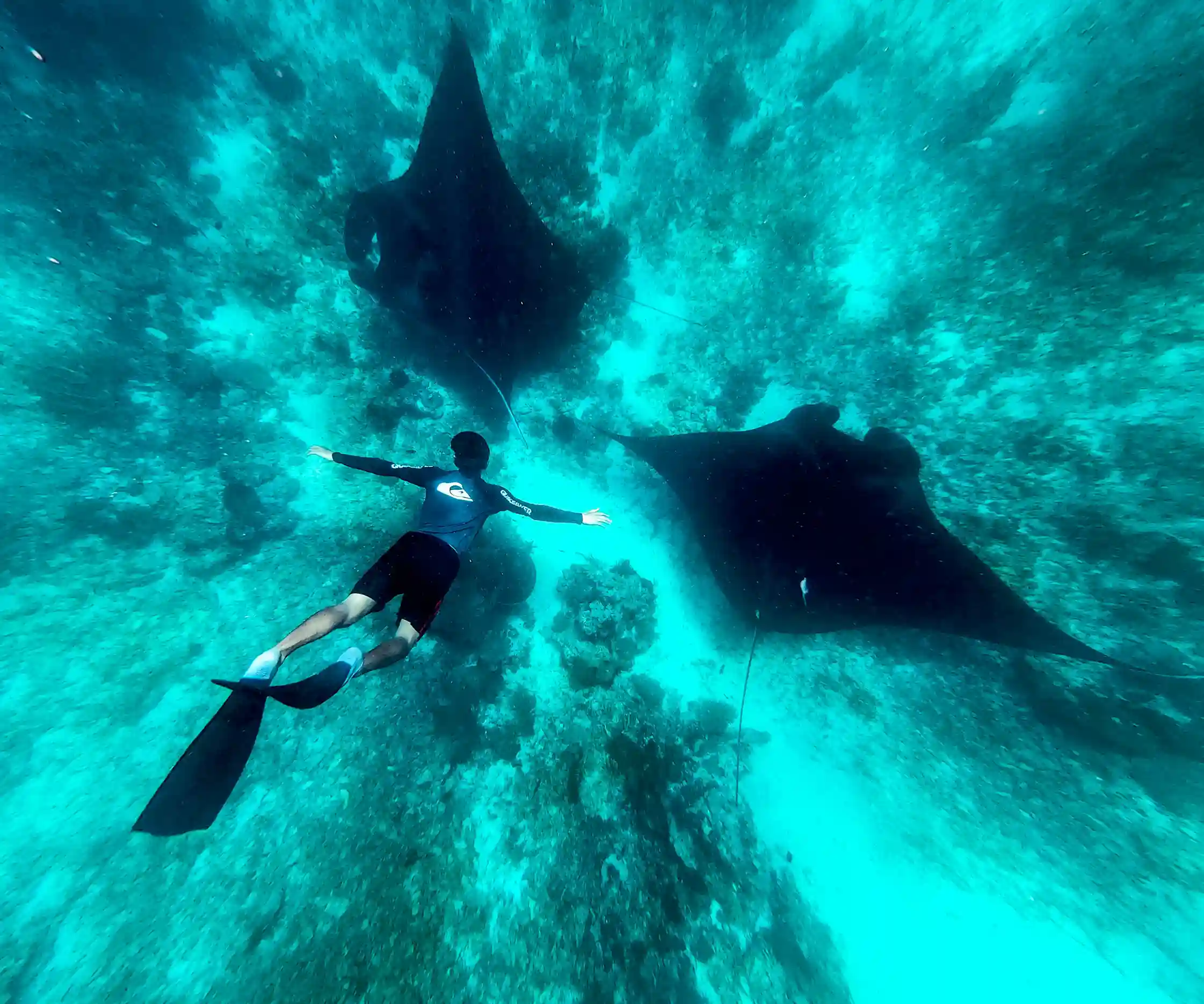
Short answer: Yes — Manta Point is one of the more solo-friendly experiences in Komodo National Park, mainly because a shared speedboat trip splits the boat cost among unrelated travellers by design, so a solo traveller isn’t penalised the way they would be booking a private charter alone. Group snorkelling with a guide is also inherently social, making it an easy way to meet other travellers on the same trip.
Last updated: August 2026.
Why solo travellers should default to a share trip, not a private charter
A private charter’s cost is fixed regardless of group size, which means a solo traveller pays the entire boat cost alone rather than splitting it — this is the single biggest cost factor for solo Komodo trip planning. A share trip flips this: the boat cost is split among however many unrelated travellers join that departure, so solo travellers pay a fraction of what a private charter would cost. Unless a specific, private experience matters more to you than saving money — a proposal, a very specific schedule requirement — a share trip is the sensible default for solo Manta Point visits.
Safety considerations for solo travellers
Manta Point’s current means staying with your guide and group matters more than at a calm, static reef — see our conditions and currents page for the full detail on why. As a solo traveller without a buddy of your own, make sure the operator pairs you with the group or assigns you a guide buddy rather than leaving you to snorkel independently; a reputable operator running group trips will do this as standard practice, but it’s worth confirming when booking if you’re at all unsure of your own comfort level in moderate current.
Basic solo-travel safety practices apply here as anywhere: share your day’s itinerary and expected return time with someone (a hotel, a friend, or family back home), keep a copy of your park permit and ID accessible, and carry a fully charged phone in a dry bag in case you need to reach your operator or accommodation after the trip, and note down the operator’s WhatsApp number separately from your phone in case it’s inaccessible for any reason during the day.
Meeting other travellers
A share trip’s mixed group is, for many solo travellers, one of the appeals rather than a downside — spending a day snorkelling, chatting on the boat between sites, and sharing the excitement of a manta encounter with people you just met is a genuinely social experience. If you’re travelling solo through Labuan Bajo and looking to meet people, a shared Manta Point day trip is a low-effort way to do that compared to, say, booking a fully private experience where you’d have no one else to share it with.
Budgeting for a solo Manta Point day
Because Komodo National Park’s mandatory ranger fee is charged per group of 1-5 people rather than per individual (see our park fees page for the full breakdown), a solo traveller technically covers that entire per-group fee alone unless the operator pools it across the boat’s full group of paying guests — worth clarifying when you book, since practice varies. The park entrance fee itself (IDR 250,000 for foreign visitors under PP No. 36/2024) is per-person regardless of group size, so that part of your cost doesn’t change whether you travel solo or in a group.
| Cost item | How it’s typically split for a solo traveller |
|---|---|
| Park entrance fee (IDR 250,000, foreign visitor) | Per person — same whether solo or in a group |
| Ranger/guide fee (~IDR 150,000 per group of 1-5) | Usually pooled across the boat’s paying guests on a share trip; potentially borne alone on a private charter |
| Boat charter cost | Split among all travellers on a share trip; borne entirely alone on a private charter |
| Gear rental, food, extras | Usually per-person regardless of group size |
Should a solo traveller consider an open trip instead?
A multi-day open trip (several days and nights on a shared liveaboard) can be an even more social option for solo travellers, since you’re grouped with the same set of travellers for the full trip rather than just one day, which can lead to deeper connections than a single-day share trip. The trade-off is less control over your itinerary and roommate arrangements if cabins are shared — confirm cabin arrangements specifically if privacy matters to you, since some open trips assign solo travellers to share a cabin with another solo traveller of the same gender by default.
Solo-friendly logistics beyond the boat trip itself
Getting from the airport to your accommodation and then to the harbour is straightforward solo — see our airport to harbour guide for the short transfer details. Labuan Bajo’s compact harbour-front area makes it easy to walk between hostels, restaurants and the harbour without arranging transport for every trip, which is a practical plus for solo travellers managing their own schedule without a group to coordinate with.
What to pack as a solo traveller
The same packing list applies to solo travellers as anyone else booking a manta snorkel day — see our full what to bring guide. One solo-specific note: since you won’t have a travel companion to watch your bag on the boat, a secured dry bag you can keep with you (rather than leaving valuables unattended) is worth the small extra care.
Frequently asked questions
Is it safe for a solo traveller to snorkel at Manta Point?
Yes, with a properly guided group and standard safety practices — staying with the group, following the guide’s positioning instructions, and confirming the operator pairs solo travellers appropriately rather than leaving them to manage the current alone.
Will I pay more as a solo traveller?
Per-person costs on a share trip are generally the same regardless of whether you’re travelling solo or with companions — you’re simply one more person splitting the shared boat cost. A private charter is where solo travel becomes noticeably more expensive per person.
Can I book a share trip last minute as a solo traveller?
Often yes, though availability depends on season and how full existing departures are — see our share trip page for booking timing guidance, and consider booking a few days ahead during Labuan Bajo’s busier July-August and December-January periods.
Are solo female travellers commonly seen on Komodo boat trips?
Yes, shared boat trips and open trips in Labuan Bajo are a well-established part of the region’s backpacker and independent-travel circuit, and solo travellers of all genders are a routine part of most operators’ guest mix rather than an unusual booking.
Is there a best season for a solo traveller specifically?
No season-specific advantage exists for solo travellers beyond the general manta-season trade-offs covered on our season page — the dry season’s calmer conditions and clearer water may appeal to a first-time solo snorkeller, while the wet season’s bigger aggregations may appeal to a more experienced solo traveller comfortable with lower visibility.
Book your solo Manta Point trip
Komodo Luxury’s shared departures and weekday open trip options are both solo-friendly ways to visit Manta Point without paying for a private boat alone. Message their team on WhatsApp, mention you’re travelling solo, and ask about current group sizes and how the ranger fee is split on the trip you’re considering.
Solo female safety realities at Manta Point and in Labuan Bajo
Solo female travellers commonly report feeling comfortable in Labuan Bajo and on boats heading to Manta Point, but the environment is still conservative and remote. In town, modest clothing away from the waterfront bars reduces unwanted attention, especially at night. Choosing guesthouses on well-lit streets near the harbour simplifies early-morning pick-ups and late returns from the boat.
On board, crews are used to mixed groups and single travellers, including women travelling alone. Standard practice is shared deck space and sometimes shared cabins on overnight trips, so confirm sleeping arrangements in advance if you prefer a same-gender cabin or upper bunk. Clarify whether there is a private changing area rather than relying on shared bathrooms at busy times between dives or snorkelling sessions.
At sea, the greatest objective risks are environmental, not social: currents, waves and the distance from medical facilities. Wearing exposure protection appropriate to water that runs 25–29 °C at the surface and falls to about 22 °C in mid-year thermoclines lowers the risk of cold stress, which can impair judgement during strong drift snorkels. Carrying your own whistle and a small high-visibility marker (such as a compact surface marker or bright hood) makes you easier to locate if separated in reduced visibility or choppy conditions.
Harassment reports offshore are infrequent, but boundaries still matter. If any crew behaviour feels uncomfortable, speak up early and clearly, and, if necessary, move closer to other guests in communal areas. Before booking, ask for clear written briefings on emergency procedures, oxygen availability and guide-to-guest ratios; operators who provide these details transparently tend to run more structured, predictable trips that suit solo female travellers.
Practical planning tips for solo women around Manta Point trips
Preparation before arriving in Labuan Bajo reduces decision pressure once you are on the ground. Screenshot your boat confirmation, ranger fee expectations and park regulations so you do not need to unlock your phone repeatedly at the pier. Share your day-plan and boat name with someone at home, and agree a check-in time after you return from Karang Makassar, allowing for common delays on the water.
During briefings, position yourself where you can both hear and be heard. Many instructions about currents, entry techniques and manta interaction rules are delivered in a single pass. If anything is unclear, ask for a repeat before the engines start. Solo snorkellers in particular should ensure the guide knows their comfort level in strong current and is aware they are travelling without a buddy.
On the boat, keep valuables consolidated and out of sight once you depart Labuan Bajo. A small dry bag with a strap that can be clipped to a fixed point reduces the chance of accidental mix-ups on crowded decks. Keep only what you need for the day: passport, larger sums of cash and backup cards are better left in a locked room safe at your accommodation than in a shared gear area.
Early return to town after a Manta Point day trip is common, but post-trip tiredness can make you less attentive. Plan dinner within walking distance of your room, and organise the next morning’s logistics before you shower. Booking follow-up activities and payment arrangements through a single channel such as sales@komodoluxury.com or WhatsApp +62 811-3823-875 reduces the need to negotiate plans on the street late in the evening.
Frequently asked questions
Is there mobile phone reception at Manta Point Komodo in case of emergencies?
There is usually patchy mobile reception around Manta Point, but it is not reliable enough to depend on in an emergency. Signal strength varies with your provider, sea state and boat position, and can drop out entirely. Safety planning should assume no phone coverage, with oxygen on board, radio contact with other vessels and clear crew procedures as the primary emergency backbone.
Are there eco friendly and ethical operators for Manta Point Komodo?
There are operators that follow eco-oriented and ethical practices on trips to Manta Point and elsewhere in Komodo National Park. The most useful indicators are strict briefings on distance from manta rays, no-touch policies, small group sizes and respect for the cleaning station. Ask specifically how crews handle crowded sites and whether guides intervene when guests disturb animals or stand on coral.
Keep reading
Trip Planning
Reef-Safe Sunscreen for Manta Point
Wear mineral reef-safe sunscreen (zinc oxide or titanium dioxide, non-nano) for any Manta Point Komodo trip. We have not found…
Trip Planning
Renting Snorkel & Dive Gear in Labuan Bajo
Most Manta Point boat trips include basic snorkel gear — mask, snorkel and fins — in the price, while wetsuits,…
Trip Planning
Best Time of Day to Visit Manta Point
The best time of day to snorkel at Manta Point is driven by tide, not the clock — guides aim…