
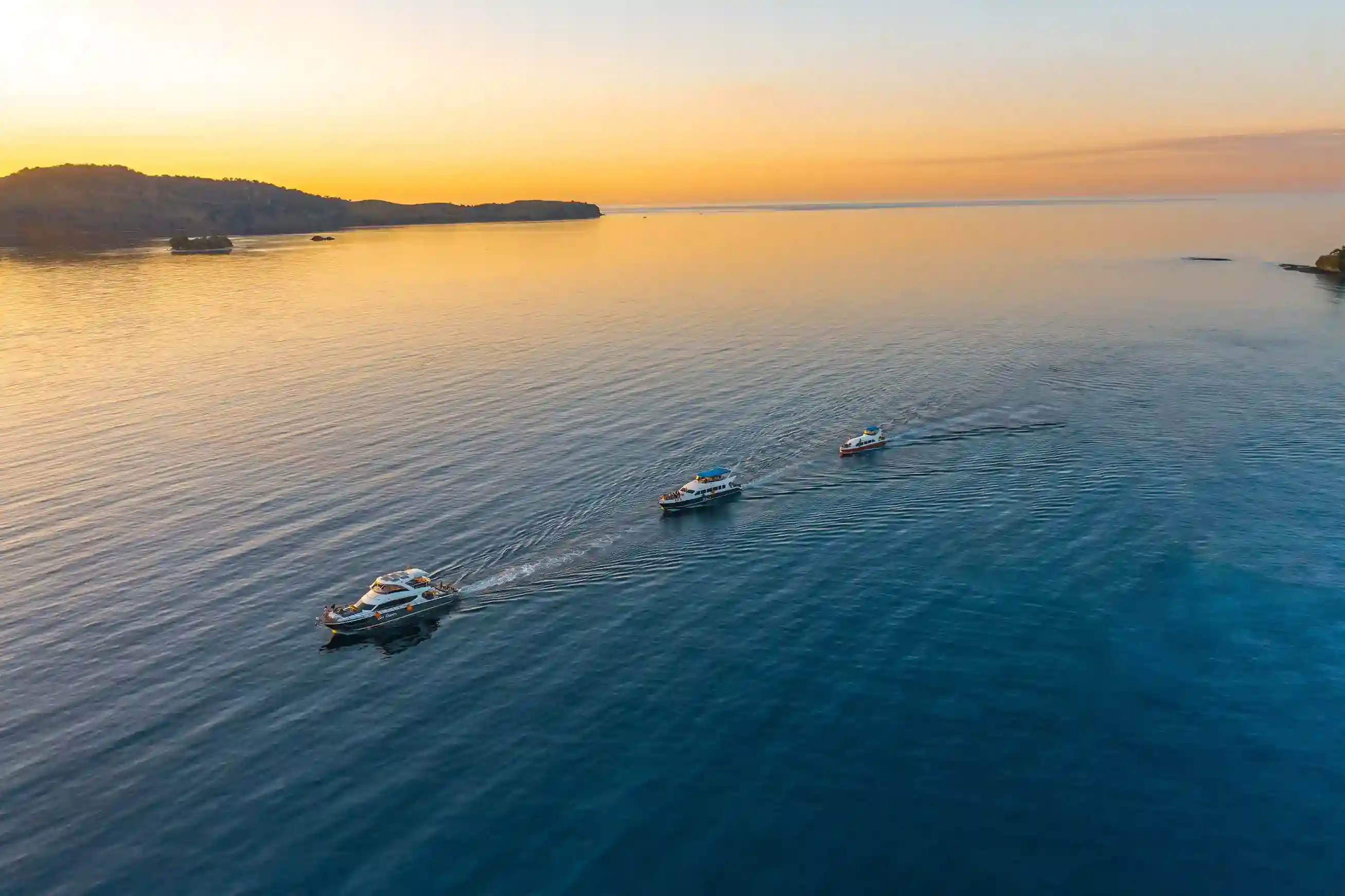
A day trip gives you one Manta Point session, typically 30-60 minutes in the early-to-mid afternoon, shared with other operators’ boats on the same standard circuit. A liveaboard can time the site against the tide rather than a fixed clock, potentially offering more flexible access and lower crowding, spread across a multi-day itinerary covering more of Komodo National Park. Neither guarantees a manta sighting.
The core trade-off in one place
| Factor | Day trip | Liveaboard |
|---|---|---|
| Total trip length | 1 day, return to Labuan Bajo | Multiple days/nights aboard |
| Manta Point sessions | One, typically 30-60 minutes | Timed against tide; potentially more than one across the trip |
| Time of day at the site | Commonly early-to-mid afternoon (shared with other day boats) | Flexible — can target off-peak windows |
| Crowding | Higher — many operators converge on the same afternoon slot | Lower on average, especially outside peak hours |
| Other Komodo sites covered | 1-2 additional stops same day (e.g. Padar, Pink Beach) | Multiple sites across the itinerary, potentially including north-Komodo dive sites |
| Cost | Lower per person, especially on a shared boat | Higher, reflecting multi-day accommodation and crew |
| Best for | Limited time, budget-conscious, first Komodo visit | Divers, photographers, longer itineraries, less crowding |
Why a day trip gives you less time at the site
A day trip is built around a full round-trip from Labuan Bajo within a single day, which means the boat has a hard return deadline and a fixed amount of daylight to work with. Given the roughly 1-1.5 hour crossing each way, plus other stops most itineraries bundle in (a Padar hike, a dragon trek, Pink Beach), the time actually available at Manta Point is necessarily limited — operator itineraries commonly describe a single 30-60 minute in-water session. This is a structural feature of the format, not a flaw specific to any one operator: there simply is not enough daylight in a single day to do a leisurely, tide-optimised visit to Manta Point plus everything else a standard day-trip circuit includes.
Why a liveaboard can offer more flexible access
Because a liveaboard sails between overnight anchorages rather than returning to harbour each evening, it is not locked into a single fixed daily circuit the way a day-trip boat is. That flexibility lets a liveaboard’s captain and crew time a Manta Point stop against the tide — potentially reaching the site in calmer conditions, at a different time of day than the day-trip convergence window, or with a second attempt built in if the first pass has poor conditions or low manta activity. Multi-day itineraries (see our 4D3N cruise page for a representative example) also have room to combine Manta Point with sites further from Labuan Bajo that a single-day trip cannot reach at all.
Crowding: what actually differs
Because so many day-trip operators build a similar circuit around similar timing, Manta Point in the early-to-mid afternoon regularly sees multiple boats and groups in the water at once — this is the price of the format’s efficiency, not a sign of a badly run trip. A liveaboard’s ability to shift its visit outside that peak window is the main lever available for reducing crowding at the site itself; it does not eliminate the possibility of other boats being present (Manta Point is popular across every trip format), but it meaningfully improves the odds of a quieter session compared to the guaranteed peak-hour convergence a standard day trip produces.
Cost: what you’re actually paying for
A day trip’s lower cost reflects that you are paying for a single day of boat time, fuel, crew and one round-trip crossing. A liveaboard’s higher cost reflects multiple days of accommodation, meals, and crew time, plus covering more distance and more sites across the park — it is a different, larger product, not simply a marked-up version of the same day trip. Neither pricing structure is fixed on this page, since both depend on operator, boat type, cabin category and group size; see Komodo Luxury’s one-day trip page and liveaboard page for current options and quotes.
Which format actually improves your odds of seeing mantas?
Neither format changes the underlying biology — mantas are wild animals responding to tide and plankton, not a scheduled show tied to trip format. What a liveaboard changes is your flexibility to time the attempt against conditions, and potentially to get more than one attempt across a multi-day trip, both of which can modestly improve your odds compared to a single fixed-time day-trip session. December-March remains the higher-odds season regardless of which format you choose — see our water conditions by season page for the full, sourced seasonal breakdown.
What each format is like on the boat itself
A day trip’s boat is a means to an end — you board, travel, visit sites, and disembark the same day, so comfort matters mainly for the multi-hour crossings rather than for extended living aboard. A liveaboard’s boat is your accommodation, dining room and social space for the length of the trip, which means cabin quality, shared-space comfort, and crew service matter far more to your overall satisfaction than they do on a single-day format. If you have not spent multiple nights aboard a boat before, it is worth being honest with yourself about how you handle several days without a hotel room, private bathroom (on shared-cabin boats), or the option to simply step off if you want a change of scenery — these are real adjustments for some travellers, not universal preferences.
Mixing formats across a longer Komodo stay
Some travellers do both: a shorter day trip early in their Labuan Bajo stay to get an initial Manta Point encounter and see other highlights quickly, followed later by a multi-day liveaboard if the trip and budget allow, or vice versa. This is a reasonable way to hedge against a single poor-conditions day, though it obviously costs more than choosing one format outright. If your schedule and budget only allow one trip, weigh the decision factors above rather than assuming either format is objectively “better” — they serve different priorities.
Booking timeline differences between the two formats
Day trips can often be booked closer to your travel date than a multi-day liveaboard, since a shared-boat day-trip operator can typically accommodate more last-minute demand than a multi-cabin liveaboard with a fixed departure schedule and limited cabin inventory. If you are planning a liveaboard, particularly during December-March peak season, book meaningfully further ahead than you would for a day trip — cabin availability on popular boats for peak dates is genuinely limited, unlike a shared day-trip boat that can often add capacity or run an additional departure. If you are shopping across several liveaboard operators before locking in dates, a general listing such as Komodo Liveaboard Luxury is worth a look alongside direct quotes.
One practical way to hold the comparison in your head: a Komodo island liveaboard sells nights, a day trip sells daylight. That single difference explains most of the price gap, and it is also why the liveaboard’s manta window is usually the calmer of the two.
A simple way to decide
- Limited time in Labuan Bajo, first visit, budget-conscious: choose a day trip.
- Serious diver or photographer wanting more time and less crowding at Manta Point: choose a multi-day liveaboard.
- Couple wanting privacy and pace over covering the most sites: consider a private honeymoon-style charter, day or multi-day.
- Uncertain about certification requirements for diving either format: check our certification guide before booking.
Frequently asked questions about day trip vs liveaboard
Is a liveaboard better than a day trip for seeing mantas?
It offers more flexible timing and potentially lower crowding, which can modestly improve your odds, but neither format guarantees a sighting.
How much time do you actually spend at Manta Point on a day trip?
Operator itineraries commonly describe a single 30-60 minute in-water session, typically in the early-to-mid afternoon.
Is a day trip enough to properly experience Manta Point?
For most first-time visitors, yes — you get a genuine snorkel or dive session at the site. Divers and photographers wanting more time or less crowding often prefer a liveaboard.
Can a liveaboard visit Manta Point more than once?
Some itineraries build in a second attempt if conditions or manta activity are poor on the first pass; this depends on the specific boat’s route flexibility, so confirm when booking.
Last updated: 26 August 2026. This page compares trip formats, not fixed prices — see the linked Komodo Luxury product pages for current quotes based on your dates and group size.
Timing your visit: morning, afternoon, and overnight access
Most day boats from Labuan Bajo reach Manta Point in the late morning, after visiting another site. That timing often coincides with more boats on the plateau and more surface chop as the sea breeze picks up. You still have solid chances of manta encounters, but guides may need to work around several groups already in the water.
Earlier access tends to come from overnight itineraries. Liveaboard schedules can put divers in the water soon after sunrise, before most day tours arrive, or return again in the late afternoon when some traffic has cleared. Those windows can feel calmer at the surface and give dive guides more flexibility to choose the best current phase for a drift or cleaning-station stop.
There is no fixed “best” time of day across the year. Feeding activity during the wet season can peak at different tidal stages, and in the clearer dry-season months the mantas may favour the cleaning stations for longer stretches. Asking your guide how they are timing entries against that day’s tide tables and wind forecast matters more than insisting on a particular clock time.
How liveaboard itineraries use Manta Point within Komodo
Many liveaboard routes treat Karang Makassar as one element in a broader circuit through Komodo National Park. On shorter two- or three-night trips, Manta Point is often paired with Batu Bolong or Castle Rock on the same day, using the manta site as either the first or second dive depending on currents. Longer itineraries may include both Manta Point and Manta Alley, giving you exposure to different manta behaviours and water conditions north and south of Rinca.
Boat captains have to balance manta-focused dives with other well-known reefs and pinnacles, as well as mandatory park check-ins and safe passages through strong channels. This means some trips will schedule only one visit to Manta Point, while others may plan two or three shorter stops spread across several days. Reading the sample itinerary carefully and asking how many potential manta sessions are planned is more informative than just counting the total cruise nights.
Liveaboard pricing is usually structured per night and reflects accommodation standard, vessel size, fuel for longer routes, and crew. Actual figures vary widely across operators and seasons, and this site does not quote them. In practical terms, a single day on a liveaboard often costs more than a single day tour, but the cost per dive or per hour spent near manta habitat can be comparable once you account for multiple days on the water.
Packing and comfort: preparing for an overnight manta-focused trip
Packing for several nights on a boat in Komodo rewards simplicity. A soft duffel stows more easily in shared cabins than a hard suitcase, and quick-drying clothing is useful between dives when afternoon squalls pass through. Even though surface temperatures are warm, a light jacket or hoodie is worthwhile on the sundeck in the wind, especially after repeated dives in cooler upwelling during the July–September dry-season core.
Dive and snorkel gear is normally rinsed and stored on deck, so you do not need duplicates. A 3 mm wetsuit suits most people in the north for much of the year; cold-sensitive guests aiming for both Manta Point and southern sites such as Manta Alley often appreciate a 5 mm suit or at least an extra hooded vest. Ear protection, a mask that fits you well, and spare contact lenses or prescription solutions reduce minor issues that can cut a dive day short.
Cabins and communal areas can feel compact compared with land accommodation. Earplugs help if you are a light sleeper near engine or compressor spaces, and a small dry bag keeps electronics safe during tender transfers or sudden rain. Charging points are shared, so bringing a multi-port USB charger makes it easier to rotate cameras and phones between dives without relying on numerous sockets.
Frequently asked questions
What is the average cost of a Manta Point Komodo day trip?
A typical day tour to Manta Point costs less than a night on a liveaboard, but exact averages differ widely by operator, boat type, and season. You also need to add the Komodo National Park fee of IDR 250,000 per foreign visitor under PP No. 36/2024, plus ranger and conservation charges. Comparing what is included in each offer matters more than chasing a single “normal” price.
Should I choose a day trip or liveaboard to maximize manta encounters at Manta Point?
If your only goal is maximising potential encounters at Manta Point, a liveaboard usually has the edge because it can time multiple visits around tides and avoid some peak crowding. A well-planned day trip during the main manta season can still be very productive, especially for snorkellers. The better choice often depends on how much time you have and whether you want to see other parts of Komodo National Park.
What are the main advantages of visiting Manta Point Komodo on a liveaboard trip?
The main advantages are flexible timing and repeated access. A liveaboard can visit Manta Point more than once, choose early or late entries, and combine the site with other high-current reefs without long daily transits from Labuan Bajo. You also avoid daily packing and unpacking of gear. The trade-off is higher total trip cost and committing several days of your schedule to one vessel and itinerary.
Which is more reliable for mantas, a liveaboard or a day trip?
Neither format guarantees manta sightings, but an overnight itinerary is generally more reliable because it offers multiple dives or snorkels across changing tides and conditions. A single day trip concentrates all your chances into one short window, which is efficient on time but more exposed to bad luck with weather or visibility. Reliability in practice also depends heavily on the guide’s local experience.
Online booking Manta Point Komodo day trip vs walk in?
Booking online in advance is safer if you have fixed dates, limited days in Labuan Bajo, or specific sites you want to prioritise. Walk-in bookings can work in low and shoulder seasons but risk limited boat choices or fully booked departures on popular days. Online systems also handle Komodo National Park ticketing via SiOra ahead of time, reducing early-morning administration before departure.
Manta Point Komodo half day vs full day snorkeling trip?
A full-day snorkelling tour increases the chance that conditions line up well for a manta session, because operators can adjust the order of sites and wait for better current or light. True half-day options are rare due to the travel time from Labuan Bajo, and they leave almost no buffer if visibility, wind, or crowds are poor on arrival. Most visitors are better served by a full day on the water.
Can I stay overnight near Manta Point Komodo on liveaboard?
Yes, many liveaboards anchor within reasonable transit distance of Manta Point and visit the site across two days of a cruise. You sleep on the vessel rather than on land near the reef itself, as there are no guesthouses at Karang Makassar. Overnighting on board allows early or late sessions without the long daily return run to Labuan Bajo.
Seaesta vs sudamala which is better for manta Komodo trip?
This site does not compare specific accommodation or boat brands, and it does not publish ratings. Both land-based stays and liveaboards can reach Manta Point, so the key differences are itinerary design, group size, safety standards, and how many opportunities you have in manta habitat. Asking each provider how often they schedule Karang Makassar and at what times is more informative than focusing on brand names.
How many hours at Manta Point Komodo on day trips?
Most day tours allocate one or two sessions at Manta Point, often totalling around an hour or slightly more in the water, depending on current and boat schedule. Time at the actual reef plateau is limited by safety, other planned sites, and park rules. Some itineraries return to the area if conditions are favourable, but you should not expect to spend the whole day just at that one location.
Keep reading
Trip Planning
Reef-Safe Sunscreen for Manta Point
Wear mineral reef-safe sunscreen (zinc oxide or titanium dioxide, non-nano) for any Manta Point Komodo trip. We have not found…
Trip Planning
Renting Snorkel & Dive Gear in Labuan Bajo
Most Manta Point boat trips include basic snorkel gear — mask, snorkel and fins — in the price, while wetsuits,…
Trip Planning
Best Time of Day to Visit Manta Point
The best time of day to snorkel at Manta Point is driven by tide, not the clock — guides aim…