
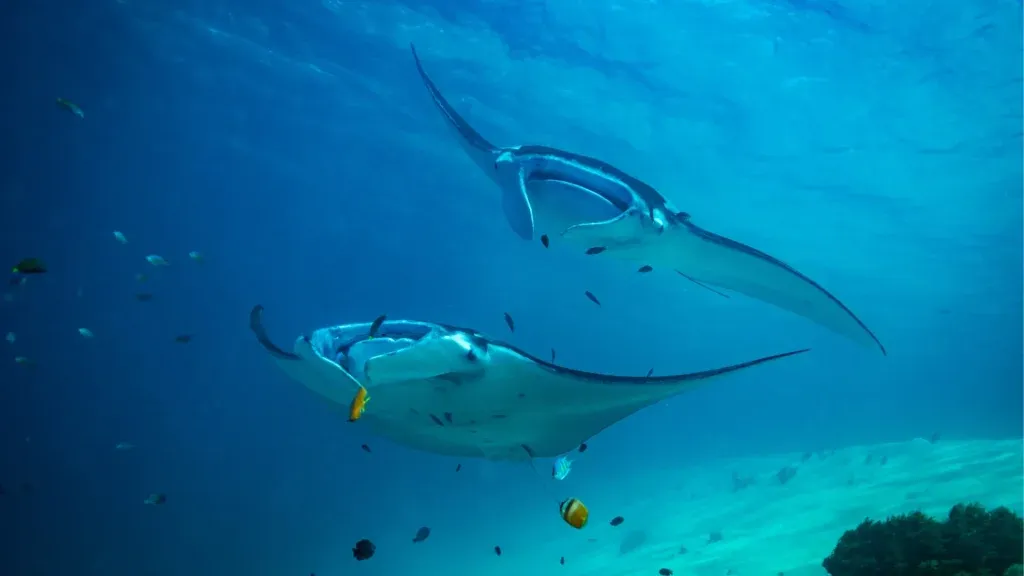
Short answer: Manta rays gather at Manta Point (Karang Makassar) because it sits in a narrow tidal channel where currents concentrate plankton over a shallow reef plateau, giving filter-feeding mantas an efficient place to feed, plus reef patches where cleaner fish service them. Season shifts which behaviour dominates: wet-season monsoon water carries more plankton (more feeding), dry-season water is clearer (more cleaning-station activity), but the underlying mechanism — tide-driven current over a shallow channel plateau — operates year-round.
Last updated: August 2026.
The geography that makes this site work
Karang Makassar sits in the channel between Komodo Island and Tatawa Besar, a constriction point in the Komodo Strait. When water is forced through a narrower gap like this on a rising or falling tide, it speeds up — the same basic fluid-dynamics principle behind any strait or channel current. That accelerated flow crosses a shallow reef plateau (a 2-5 m snorkel shelf falling away to the 8-18 m dive zone) rather than a deep, open channel, which matters because a shallow plateau lets divers and snorkellers actually access the current-swept water column where mantas are feeding, rather than the phenomenon happening in inaccessible deep water.
Why current concentrates plankton
Plankton doesn’t swim against current in any meaningful way — it drifts with the water mass. When that water mass is forced to accelerate through a narrow channel and pass over a shallow plateau, plankton gets funnelled and concentrated along a predictable path rather than being spread thin across open water. For a filter feeder like a manta ray, that concentration is the entire point: swimming in open water hoping to encounter enough plankton to be worth the energy expended is inefficient, but positioning at a reliable current-concentration point is not. This is the same underlying logic behind why many of the world’s best manta and whale-shark aggregation sites are found at capes, channels and current convergence points rather than in open, unstructured water.
Two monsoon systems, two different water masses
Indonesia’s seasonal wind reversal — the Asian-Australian monsoon system — drives two distinct current and water-mass patterns through the region each year:
- Northwest monsoon (roughly November-March): Brings warmer, lower-salinity, more nutrient-rich surface water associated with higher plankton density into the Komodo Strait area. This lines up with the wet-season feeding-aggregation pattern described on our season page.
- Southeast monsoon (roughly April-October): Drives cooler water and, in many parts of the region, upwelling patterns associated with clearer water. This lines up with the dry-season clarity and cleaning-station behaviour pattern.
This broader regional oceanographic pattern is well established for the Flores Sea and Indonesian Throughflow system generally; what is less formally documented in a site-specific, peer-reviewed way is the exact plankton-density measurement at Karang Makassar itself month by month. What we can say with reasonable confidence is that the qualitative pattern reported consistently across independent dive operators (more plankton and lower visibility in the wet season; clearer water and steadier cleaning behaviour in the dry season) is consistent with this known regional monsoon mechanism, even without a dedicated published study pinned specifically to this reef.
Feeding vs cleaning: two different manta behaviours, two different drivers
It’s worth separating what mantas are actually doing at Manta Point, since the two behaviours have different drivers:
| Behaviour | What it looks like | Primary driver | More common in |
|---|---|---|---|
| Feeding | Barrel rolls, looping swims with cephalic fins unfurled through dense water | Plankton density | Wet season (roughly December-March) |
| Cleaning | Hovering near a reef patch while cleaner fish work over the body and gills | Water clarity and presence of an active cleaning station | Dry season, most typically its June-September core |
Both behaviours can occur at any time of year depending on local, day-to-day plankton conditions — the seasonal pattern is a tendency, not a rule. A manta encountered mid-cleaning in December or mid-feeding in July is not unusual, just less typical than the reverse.
Cleaning stations: the biology behind them
Cleaning stations are specific reef patches where small fish — commonly cleaner wrasse (Labroides dimidiatus) — pick parasites, dead skin and debris from larger animals that visit and hold position nearby. This is a genuine mutualistic relationship: the cleaner fish get a meal, and the manta gets pest removal it can’t perform on itself. Mantas often return to the same cleaning stations repeatedly, which is part of why certain specific spots on the Karang Makassar plateau are more reliably productive for divers than others, and why an experienced local guide’s knowledge of exactly where to position the group on a given day matters as much as the site’s general reputation as a whole.
Why the tide matters more than the clock
Because the mechanism driving both plankton concentration and current strength is tidal, not solar, the single biggest factor in a good day at Manta Point on any given date is not what time you arrive but where the tide cycle sits that day. Spring tides (around new and full moon) produce stronger currents; neap tides produce gentler ones. Local guides check tide tables specifically for this reason, and the same calendar date can produce quite different conditions from one lunar cycle to the next. For the practical, day-to-day implications of this for current strength and diver/snorkeller comfort, see our conditions and currents page.
What this page is careful not to overstate
The monsoon-driven current and plankton mechanism described above is well established for the broader Flores Sea and Indonesian Throughflow region. What is not established, at least in any publicly available, peer-reviewed source we could locate specifically for Karang Makassar, is a precise measured plankton-density time series for this exact reef. The connection this page draws between the regional oceanographic pattern and the site-specific manta behaviour reported by dive operators is a reasonable, well-supported inference, not a claim of a dedicated published study pinned to this one location. We think that distinction matters and would rather state it plainly than imply a level of scientific certainty the public record doesn’t actually support.
Frequently asked questions
Do manta rays actively hunt plankton, or just swim through it passively?
They actively feed — unfurling their cephalic fins to funnel water and plankton toward their mouths, and sometimes performing barrel rolls or looping swims to pass repeatedly through a dense patch, rather than simply drifting through incidentally.
Is the current at Manta Point always caused by the same mechanism?
Yes — it’s a tidal channel-constriction current, driven by the tide cycle, throughout the year. Season changes the water mass characteristics (temperature, plankton density, clarity) riding on top of that current, not the underlying tidal mechanism itself.
Why don’t mantas just stay at Manta Point permanently instead of moving between feeding and cleaning?
Feeding and cleaning serve different biological needs (energy intake vs. parasite removal), and mantas are believed to move between different sites and behaviours within their home range based on which need is more pressing and where conditions are currently best, rather than performing both activities constantly in one spot.
Does understanding the tide help me choose a better trip time?
It can, though most travellers don’t control their trip timing precisely enough to target a specific tide phase — a good local operator building your day’s schedule around the tide is generally more useful than trying to calculate it yourself in advance.
Does moon phase matter for a manta trip?
Indirectly, yes — moon phase drives the spring/neap tide cycle, which drives current strength. It doesn’t determine manta presence directly, but it does affect how strong the drift will feel on the day, which is one more reason a local guide’s day-of assessment matters more than a generic monthly average.
Let a local guide put you in the right place at the right tide
Understanding why mantas gather here is interesting, but putting it into practice on the day is a local guide’s job — reading the tide, positioning the boat, and knowing which cleaning stations are currently active. Komodo Luxury’s guides plan around this on every Komodo sailing trip and Komodo boat tour departure to Manta Point, rather than running a fixed schedule regardless of conditions.
Sources
Plankton, monsoon cycles and why Komodo’s mantas follow them
Manta Point sits where two seasonal wind systems – the north‑west monsoon (roughly December–March) and the south‑east monsoon (roughly June–September) – alternately push different water masses through Komodo National Park. During the north‑west phase, warmer, more productive surface water from the Flores Sea tends to dominate the northern part of the park, bringing higher plankton densities that support the well‑known wet‑season feeding aggregations.
During the south‑east monsoon, stronger trade winds drive cooler, nutrient‑rich upwelling, especially around southern channels and the area near Rinca. That cool water can pulse northwards as internal waves and thermocline surges, periodically enriching Karang Makassar with plankton despite otherwise clearer dry‑season conditions. This is why divers can encounter active feeding behaviour over the plateau even when visibility is relatively high and surface water feels less “green”.
Neither monsoon delivers a single, predictable “bloom” on a calendar date. Instead, local wind, cloud cover and rain alter stratification and mixing on time‑scales of days to weeks. Guides in Labuan Bajo tend to watch for patterns such as several days of stronger wind, cooler surface readings, or visibly greener water arriving from the south, as these often precede particularly busy feeding sessions for Mobula alfredi in both the wet and the dry core seasons.
Currents, tides and where plankton concentrates on the plateau
The broad, shallow ridge of Karang Makassar acts as a filter in the tidal stream that connects the Flores Sea and the Sape Strait. As the tide floods and ebbs through this constriction, shear and turbulence along the reef edges trap and retain planktonic organisms that would otherwise be swept straight past. This is why seemingly featureless sand and rubble can hold dense, patchy clouds of food only a few metres above the bottom.
Standing waves and small eddies form on both the up‑current and down‑current sides of coral heads and low ridges. Within these slower micro‑currents, copepods and other zooplankton accumulate into streaks and lenses that manta rays track with tight, repetitive circuits. On days when overall flow is quite strong, those lanes may sit higher in the water column and move more quickly; on gentler tides they can remain close to the substrate, favouring gliding passes over the plateau itself.
The same tidal engine that concentrates plankton also defines how safely divers and snorkellers can observe feeding. On very large ranges, such as around new and full moons, the main stream can become fast enough that only experienced participants and guides are comfortable positioning along the edges of the plateau. Neap cycles typically bring more manageable current speeds and longer periods of slack or moderate flow, which is why many operators try to time manta‑focused dives for mid‑range tides within those quieter parts of the fortnightly cycle.
How feeding behaviour and tide choice shape a manta dive
Reef manta rays at Manta Point adapt their feeding strategies to whatever the currents and tides are delivering. During strong movement of water laden with plankton, they often switch to more active patterns such as barrel‑rolling in vertical columns or forming short “trains” that repeatedly pass through a rich patch. In lazier flows, they may cruise slowly along the contour of the plateau, making wide loops that give divers longer, more predictable viewing opportunities.
From a practical planning perspective, many guides prefer a dive that starts just before peak tidal flow and ends as it eases, or the other way round, rather than exactly at slack water. A modest but steady current tends to hold food particles in organised bands that mantas repeatedly exploit, while completely slack conditions can scatter plankton thinly and reduce focused feeding. The trade‑off is that slightly moving water demands better control from divers and snorkellers, and less experienced groups may be scheduled on milder phases of the same tide.
Choosing between an earlier or later tide within a given day also interacts with light and plankton behaviour. Low morning sun can make it easier to see silhouettes of approaching animals when they feed higher in the column, but suspended particles may be more visible as backscatter. Afternoon dives often find warmer surface layers and sometimes a second pulse of activity if wind‑driven mixing has resupplied the plateau. None of these factors guarantees manta encounters, but understanding how tides organise food explains why local timing advice usually matters more than simply selecting a particular month.
Frequently asked questions
Are there jellyfish or stinging plankton seasons at Manta Point Komodo to be aware of?
Yes, there are periods when jellyfish and irritating plankton are more noticeable, especially in the wet season when surface waters can be greener and more stratified. These organisms are usually patchy rather than continuous. Lightweight exposure protection such as a full‑length wetsuit or rash vest, plus gloves kept for surface swims only, helps reduce discomfort while still following “no contact” rules with the reef and mantas.
Do mantas at Manta Point Komodo appear more frequently during certain tides or moon phases?
They tend to use the site more actively when currents are strong enough to concentrate plankton but not so extreme that feeding becomes inefficient, which often aligns with mid‑range tides rather than the very smallest or largest. Some guides favour days around neap tides for manageable conditions, but productive feeding can occur on any phase if water movement and plankton supply line up on that particular day.
Is Manta Point Komodo affected by tides?
Yes, the plateau is strongly influenced by tidal exchange between the Flores Sea and the Sape Strait, which shapes current speed, direction and plankton concentration. Those changes alter where mantas choose to feed or clean and how easy it is for visitors to remain in position. Dive plans are typically built around local tide tables, but actual conditions can still vary with wind and recent weather.
Is Manta Point Komodo affected by strong tides?
Yes, powerful tidal flows can make the site challenging, with fast surface drift and strong horizontal currents along the reef edges. On such days, guides may limit where groups enter the water, shorten snorkel sessions, or select alternative dive profiles. The same vigorous movement of water can still attract actively feeding mantas, so the balance between encounter quality and safety is managed carefully on each trip.
Keep reading
Manta Guides
Whale Sharks, Turtles and Other Megafauna
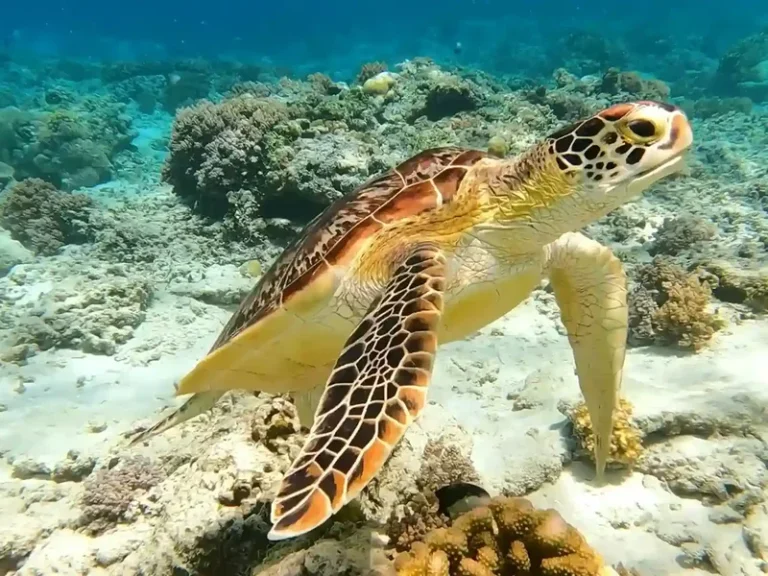
Beyond reef manta rays, Manta Point Komodo (Karang Makassar) hosts blacktip and whitetip reef sharks, eagle rays, green turtles, and…
Manta Guides
How to Identify Individual Reef Mantas
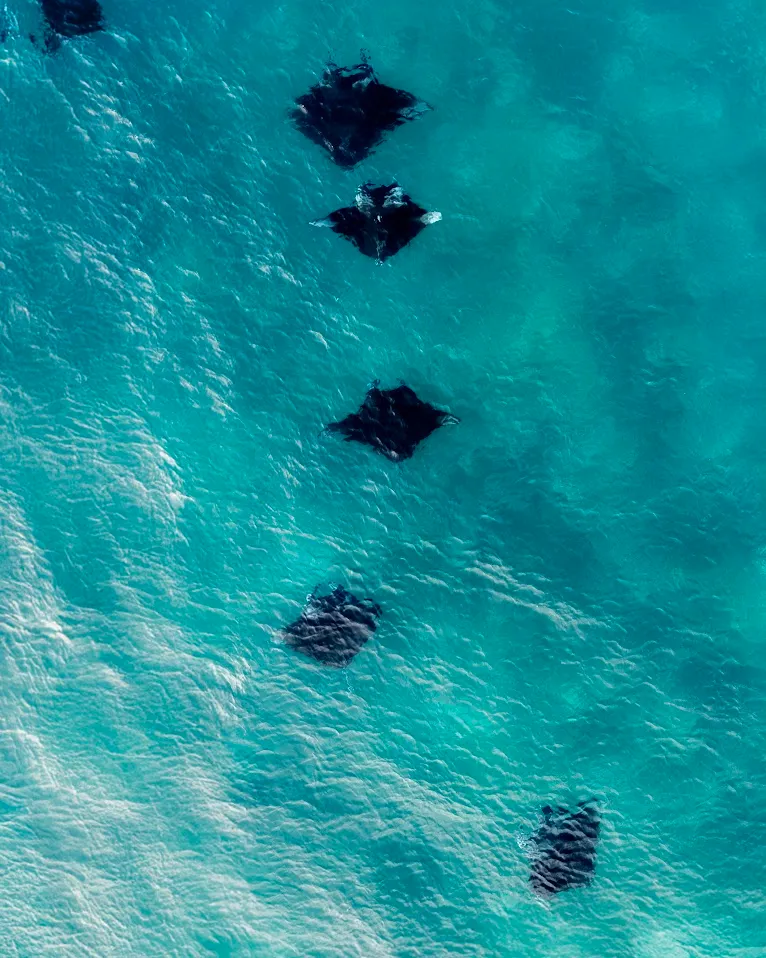
Researchers identify individual reef manta rays by the unique pattern of dark spots on their belly, especially the area between…
Manta Guides
Cleaning Station Behaviour at Manta Point
Manta Point is a cleaning station, not a feeding ground — reef mantas hover there to let small cleaner fish…