
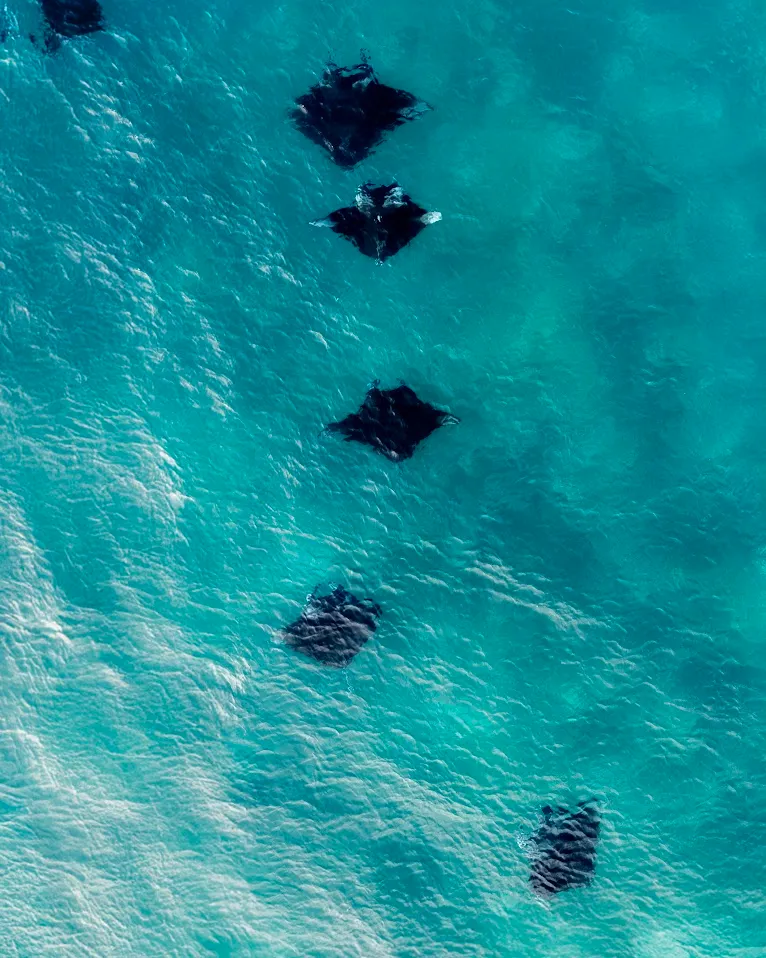
Reef manta rays (Mobula alfredi) are the manta you will almost certainly see at Manta Point, Komodo — resident, coastal, and typically 3-4.5 m across the disc. Oceanic manta rays (Mobula birostris) are larger (mature individuals commonly 4-5 m, documented maximum around 7 m) and more pelagic, appearing only occasionally at the site. Tell them apart by the shoulder patch: pale on a reef manta, dark and triangular on an oceanic manta.
Which manta species lives at Manta Point?
Komodo National Park hosts both reef manta rays (Mobula alfredi) and oceanic manta rays (Mobula birostris), but they do not use the park the same way. Reef mantas are the resident, shallow-water species and dominate sightings at coastal cleaning stations like Manta Point and nearby Manta Alley — a scientific study of Komodo’s manta population identified an aggregation of over a thousand individually catalogued reef mantas using the park’s coastal habitats, underlining how central this species is to the park’s manta tourism. Oceanic mantas are a more pelagic, wide-ranging species, more often reported around offshore seamounts during plankton surges than at inshore cleaning stations. In practice: if you see a manta at Manta Point, it is almost certainly a reef manta; an oceanic manta there is a genuine bonus sighting, not something to plan a trip around.
Size comparison: how big is each species?
| Species | Typical adult disc width | Documented maximum | Source |
|---|---|---|---|
| Reef manta ray (Mobula alfredi) | ~3-4.5 m | ~5.5 m (sources vary by measurement method) | Manta Trust species guide; FishBase |
| Oceanic manta ray (Mobula birostris) | ~4-5 m (size at maturity) | ~7 m | Australian Government fisheries assessment; Bimini Shark Lab |
The size gap is real and visible underwater: an oceanic manta encountered anywhere in Komodo waters will typically look noticeably larger than the reef mantas you see regularly at Manta Point, not just a slightly bigger version of the same animal.
How do you tell them apart underwater?
The most reliable field mark researchers and dive guides use is the shoulder patch — the marking on the animal’s back just behind the head:
- Reef manta ray: a pale, white or greyish shoulder patch, and a pale (not dark) mouth and cephalic-fin lining.
- Oceanic manta ray: a dark, triangular shoulder patch, and a dark mouth and cephalic-fin lining, sometimes described as a “dark chin.”
Beyond colouration, oceanic mantas have proportionally longer, more pronounced cephalic fins (the paddle-like lobes either side of the mouth used to funnel plankton) than reef mantas, and their overall larger size is itself a useful — if less precise — clue once you have seen both species and have a size reference in mind.
Ventral spot patterns: how researchers identify individuals
Both species carry individualised spot and marking patterns on their ventral (belly) surface, and this is standard practice in manta research for photo-identifying specific individuals over time — the same way a fingerprint or a whale shark’s spot pattern works. Manta Trust research based at cleaning stations has used exactly this approach to document repeat visits by the same reef manta individuals, evidencing strong site fidelity to specific cleaning stations like the ones at Manta Point. If you want a photograph that is useful for more than a personal souvenir, a clean, well-lit shot of the ventral surface as a manta passes overhead is the single most valuable frame for identification purposes — see our manta photography tips page for how to get it.
Why do mantas visit cleaning stations at all?
Cleaning stations are specific points on the reef — usually a raised coral bommie — where small cleaner fish remove parasites, dead skin and bacteria from a manta’s body and gill slits. Manta Trust research describes this as genuinely important to manta health: injured animals use cleaner fish to help keep wounds free of infection, and cleaning stations double as social venues, with adult mantas (particularly females) spending more time being cleaned than juveniles do. At Indo-Pacific sites in the same biogeographic region as Komodo, the key cleaner species documented include bluestreak cleaner wrasse (Labroides dimidiatus), moon wrasse (Thalassoma lunare), and Klein’s butterflyfish (Chaetodon kleinii) — the same guild reported by regional dive operators at Komodo’s own manta cleaning stations, including Manta Point.
Behaviour differences: resident vs pelagic
Reef mantas’ residency is a large part of why Manta Point works as a dependable tourism site at all — the population using the park’s coastal cleaning stations returns to the same general area repeatedly, rather than passing through once and disappearing for a season. Oceanic mantas behave differently: as a more pelagic species, they range more widely across open ocean and are drawn to specific coastal sites mainly during plankton surges rather than living there. This is also why season and tide matter more to sighting odds at Manta Point than a fixed calendar date does — reef mantas are present, but their numbers and activity still track food availability.
Conservation status of both species
Both reef and oceanic manta rays face conservation pressure globally, primarily from targeted and bycatch fisheries in parts of their range, and both are protected under Indonesian law within Komodo National Park’s waters. Komodo’s status as one of the more significant known aggregation sites for reef mantas specifically is part of why researchers and conservation groups treat the park’s population as ecologically important beyond its tourism value — a resident, catalogued population like this one is a meaningful conservation asset, not only an attraction.
Do reef and oceanic mantas ever appear together?
Yes, on rare occasions, and it is a genuinely notable sighting when it happens — the two species are not mutually exclusive at a given site, they simply use Komodo’s waters differently and at different frequencies. A day with unusually strong plankton activity in the wider Komodo channel can occasionally draw an oceanic manta into the same general area as the resident reef mantas working Manta Point’s cleaning stations. Guides who have worked the site for years generally treat an oceanic manta appearance as memorable precisely because it is uncommon, not a routine part of the encounter.
Why this distinction matters beyond species trivia
Knowing which species you are likely to see changes what to expect and how to photograph it. A reef manta at a cleaning station tends to hold a relatively fixed position while being cleaned, giving a snorkeler or diver a genuine window to approach slowly and compose a shot. An oceanic manta, being more pelagic and less tied to a fixed station, is more likely to be a single fast pass through open water rather than a lingering encounter. Setting your expectations — and your camera settings — around a reef manta encounter as the default, with an oceanic sighting as a rare bonus, matches what actually happens at this site far more often than the reverse.
Frequently asked questions about reef vs oceanic manta rays
Which manta species will I see at Manta Point in Komodo?
Almost certainly the reef manta ray (Mobula alfredi). Oceanic mantas (Mobula birostris) appear only occasionally at the site.
How can I tell a reef manta from an oceanic manta?
Check the shoulder patch just behind the head: pale/white on a reef manta, dark and triangular on an oceanic manta. Oceanic mantas are also noticeably larger and have longer cephalic fins.
Which manta species is bigger?
Oceanic mantas are larger — mature individuals commonly reach 4-5 m disc width with a documented maximum around 7 m, compared to a reef manta’s typical 3-4.5 m and documented maximum of about 5.5 m.
Why do mantas gather at cleaning stations?
Small cleaner fish (such as bluestreak cleaner wrasse) remove parasites, dead skin and bacteria from mantas at cleaning stations, which also serve as social and courtship venues for the species.
Last updated: 27 August 2026. Size and identification figures are drawn from Manta Trust species accounts, FishBase, and an Australian Government fisheries assessment as cited above; this page does not state a trip price, since it is a marine-biology reference page rather than a booking page — see our Manta Point overview for trip options, our wider manta ray facts guide for more biology detail, or Manta Point conditions and currents for how tide and current relate to sightings.
How reef and oceanic mantas actually use Karang Makassar
Across a year at Karang Makassar, almost every manta you see will be a reef manta, using the plateau as both a cleaning area and a feeding corridor. They follow predictable routes along the current-facing edge of the reef, pausing over coral heads where cleaner wrasse and other small fish remove parasites and dead skin from their bodies.
Oceanic mantas appear only occasionally and usually do not linger in the same way. When they do pass through, they tend to stay slightly deeper and more in the blue water beside the plateau rather than right on top of the main cleaning blocks. Many divers never see them here; Manta Alley and the offshore channels offer better chances, especially in the cooler, plankton-rich months.
For trip planning, this means that a visit to Manta Point is effectively a visit to observe reef mantas at fairly close range. The site’s shallow topography and consistent currents favour repeated passes by resident individuals, which helps researchers with identification and gives snorkellers long viewing windows. Treat any encounter with the larger oceanic species in Komodo as a bonus rather than an expectation.
Site layout, seasonal patterns and camera planning at Manta Point
Divers often hear both Taka Makassar and Karang Makassar mentioned in the same briefing. Taka Makassar is the sandbar and shallow coral garden used for relaxed snorkelling, while Karang Makassar is the long, rubble-and-coral plateau where mantas feed and clean. Boats usually drift along the manta corridor and then anchor or beach near the sandbar for surface intervals and easier entries.
Manta aggregations follow the broader monsoon cycle. In the wet months around December to March, plankton levels are higher and large numbers of reef mantas may feed in the shallows, though visibility can drop below 15 metres. In the core dry season from June to September, fewer individuals may be feeding at once, but sightings at the cleaning patches are highly regular and the water is clearer for observation and photography.
Underwater cameras need some adjustment to cope with Komodo’s changing light and water colour. With an action camera such as a GoPro, a frame rate of 60 fps gives smoother motion for gliding mantas, while a shutter speed at least double that helps avoid motion blur. Use a wide field of view, set white balance to a fixed underwater or 5500–6000K preset, and enable a flat colour profile if you intend to correct colours later rather than relying on heavy in-camera processing.
Memory cards fill faster than many visitors expect, especially if you record entire cleaning passes. A high-endurance U3 or V30-rated card of at least 128 GB is practical for a day with multiple dives or snorkel sessions, letting you record several hours of 4K footage without constant card changes. Cold, repeated immersion and the boat’s limited charging options also make it worth bringing a spare card and battery so you can keep filming if one reaches capacity or fails.
Currency, park fees and practical dive depths at Karang Makassar
All official park and ranger charges for Komodo National Park are collected in Indonesian rupiah. The main entry fee is set by national regulation and listed in IDR, while operators usually quote trip packages in rupiah and sometimes offer an approximate conversion to other currencies. Exchange rates move daily, so any USD figure is only a rough guide; travellers should expect the final card or cash payment to be settled locally in IDR.
The manta corridor at Karang Makassar is shallow by regional standards. The dive plateau runs 8–18 metres beneath a 2–5 metre snorkel shelf, and most cleaning passes and feeding glides happen in its busiest band, around 10–15 metres, with the plateau edges falling away past 20 metres. This gives snorkellers a realistic chance of prolonged encounters while still allowing divers to position themselves along the sides of the cleaning areas, off the coral and out of the mantas’ direct path.
Shallower depths influence your camera and buoyancy choices. Even modest surge can lift a diver onto the rubble if they are overweighted, so carrying a slightly smaller amount of lead than on deeper walls helps maintain precise control. For video, the bright surface light at 8 to 10 metres allows lower ISOs and cleaner images, but it also exaggerates backscatter; staying a little to the side of the cleaning station reduces particles between you and the animals.
Frequently asked questions
How deep is the reef at Manta Point Komodo where mantas usually circle for cleaning?
Mantas most often circle for cleaning around 10–15 metres, the busiest band inside the 8–18 metre plateau at Karang Makassar. Some passes run shallower, close to the 2–5 metre snorkel shelf, and individuals may dip below 18 metres off the plateau edge, but dive briefings target the 8–18 metre band. Snorkellers look down onto the same activity from the surface, so visibility and current strength strongly affect how well they can follow each pass.
Are gloves and reef hooks allowed at Manta Point Komodo, or are they discouraged?
Gloves and reef hooks are generally discouraged at Manta Point to reduce coral damage and prevent divers from anchoring on the cleaning station. Most guides prefer a negative entry, followed by careful finning in the sand or rubble away from coral heads. Some operators ban hooks entirely, so divers should check policies in advance and be ready to maintain position using buoyancy and streamlined profiles.
What happens if no mantas appear at Manta Point Komodo?
If no mantas show up during a planned session, the site is dived or snorkelled as a regular drift with focus on other reef life. Guides often adjust timing, entry point, or repeat the site later in the day, but there is never a guarantee of manta sightings. Operators usually do not offer specific refunds for a quiet day, because conditions and animal movements change beyond human control.
Are oceanic mantas seen at Karang Makassar Komodo?
Oceanic mantas are seen at Karang Makassar only occasionally, as visitors to a habitat dominated by reef mantas. Most trips report none, and the species is more reliably associated with deeper, more exposed channels and southern sites like Manta Alley. Treat any encounter here as rare good fortune rather than a realistic target and plan your expectations around reef manta behaviour instead.
Best way to use a reef hook at Karang Makassar?
The best use of a reef hook at Karang Makassar is usually not to deploy it at all. The cleaning blocks and rubble slopes are fragile, and hooks can easily crush coral or dislodge stones that mantas use as reference points. If an operator permits hooks, they should be clipped only into bare rock or sand patches away from cleaning stations, under direct guide instruction and with a very short line.
Manta Point Komodo small group vs large boat tours safety?
Both small-group and larger-boat tours can be safe at Manta Point when well managed and properly briefed. Smaller groups typically mean less surface congestion, simpler head counts, and easier supervision in strong current. Larger boats may offer more deck space and redundancy in equipment but demand stricter procedures so multiple entries, exits, and drifts do not overlap or create confusion in choppy water.
Keep reading
Manta Guides
Whale Sharks, Turtles and Other Megafauna
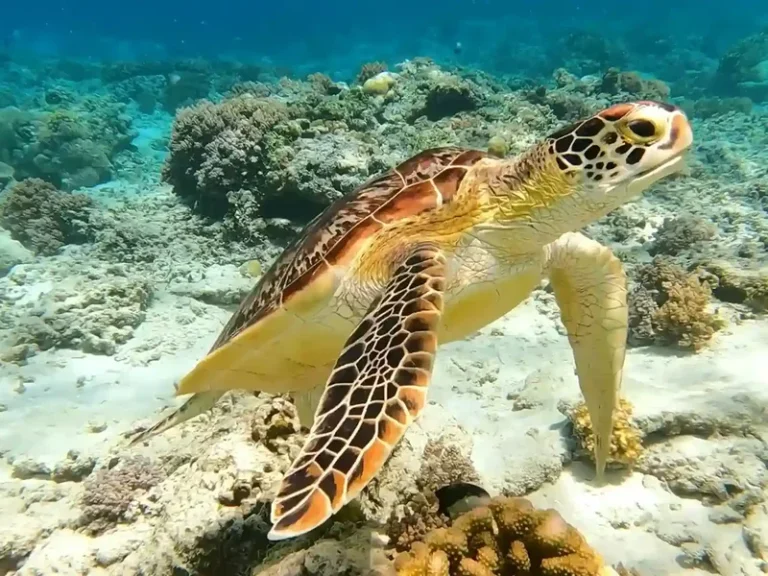
Beyond reef manta rays, Manta Point Komodo (Karang Makassar) hosts blacktip and whitetip reef sharks, eagle rays, green turtles, and…
Manta Guides
How to Identify Individual Reef Mantas
Researchers identify individual reef manta rays by the unique pattern of dark spots on their belly, especially the area between…
Manta Guides
Cleaning Station Behaviour at Manta Point
Manta Point is a cleaning station, not a feeding ground — reef mantas hover there to let small cleaner fish…