
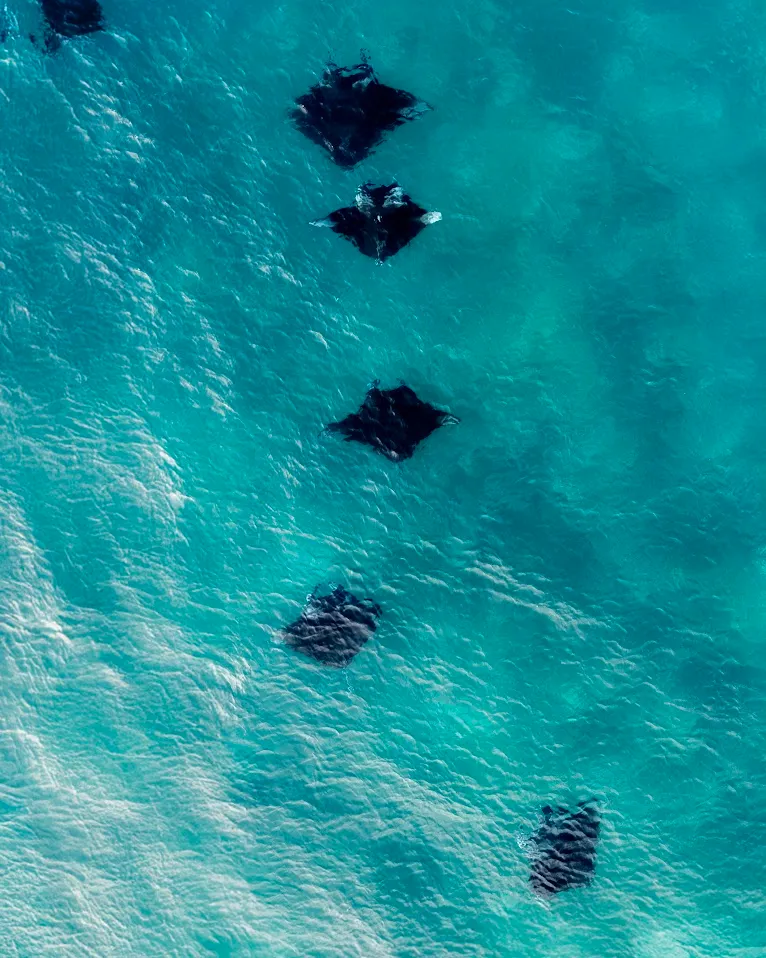
Manta Point is a cleaning station, not a feeding ground — reef mantas hover there to let small cleaner fish remove parasites and dead skin, not primarily to feed. Feeding does happen nearby when plankton concentrates in the current, but the behavior you observe at the reef itself — slow circling, hovering low over coral outcrops — is cleaning behavior.
Is Manta Point a Cleaning Station or a Feeding Ground?
Both behaviors occur in the area, but they happen in different spots and look different in the water, which is a common source of confusion for first-time visitors. The reef itself at Karang Makassar functions as a cleaning station: mantas slow down, hover close over specific coral or rock outcrops, and hold a stationary or slow-circling position while cleaner fish work over their skin, gills, and mouth. Feeding behavior — mantas swimming with mouths open, somersaulting through plankton-dense water — tends to happen in the water column above or near the site when plankton concentrates, rather than at the cleaning station itself.
How Can You Tell Which Behavior You’re Watching?
| Behavior | What It Looks Like | What is Happening |
|---|---|---|
| Cleaning | Slow, low hovering over a fixed reef spot; mouth mostly closed; small fish visibly working the body | Parasite/dead-skin removal by cleaner fish |
| Feeding | Mouth wide open, sometimes somersaulting or barrel-rolling through the water column | Filter-feeding on a plankton concentration |
| Transit / cruising | Steady, directional swimming, not hovering over one spot | Moving between sites, not actively cleaning or feeding |
Why Does This Distinction Matter for Etiquette?
A manta actively being cleaned is in a semi-stationary, lower-alertness state and is the reason cleaning stations became reliable snorkel and dive sites in the first place — you can predictably find mantas there because they return repeatedly for cleaning, not because the location happens to have good visibility. Approaching a cleaning manta the same way you would a feeding one (which is more actively moving and less predictable) is one reason guides emphasize positioning up-current and staying at fixed distance rather than tracking movement, since a hovering manta being cleaned is easily disturbed out of position by a swimmer closing in.
What Fish Do the Actual Cleaning?
Cleaner wrasse and certain butterflyfish species are the main cleaners observed at Indo-Pacific manta cleaning stations generally, picking parasites, dead skin, and food debris from the manta’s skin, gill rakers, and mouth. This is a mutualistic relationship — the small fish get a meal, the manta gets a health benefit — and it is a normal, recurring part of reef manta behavior rather than something unique to Komodo.
Does Weather or Tide Affect Which Behavior You’ll See?
Across the year, mantas are most consistently present from December to February, the peak inside the December–March wet season, while the dry stretch from April to November is clearer and calmer with fewer animals working the site. Sightings are never guaranteed. Feeding behavior is more tied to plankton concentration, which tracks tide and current more than season alone, while cleaning-station visits at Karang Makassar happen across a wider range of conditions since it is a fixed reef feature mantas return to regardless of whether plankton is currently dense in the water column. Your guide will usually be able to tell you which behavior is dominant on a given day based on what they’re seeing before you enter the water.
Do Mantas Return to the Same Cleaning Station Repeatedly?
Reef mantas are widely documented in the broader scientific literature as showing site fidelity to specific cleaning stations, returning to the same locations over months or years rather than visiting opportunistically. This pattern — combined with individually identifiable belly spot patterns — is what makes photo-identification research possible at manta sites generally, and it is consistent with what local Komodo operators report observing at Karang Makassar over repeated seasons, though a dedicated, published population study isolating return rates specifically for this site does not appear to be publicly available at the time of writing.
What Does Site Fidelity Mean for Trip Timing?
Because mantas return to the same cleaning station repeatedly rather than passing through only once, a cleaning station’s reliability builds over time — this is part of why Manta Point has a stronger sighting reputation than a random open-water crossing would. It also means that a site experiencing sustained disturbance (crowding, contact, boat traffic) can see reduced visit frequency over an extended period rather than an immediate one-day effect, reinforcing why etiquette compliance is a long-term, cumulative practice rather than a one-trip concern.
Can You See Both Behaviors on the Same Trip?
Yes — it is common to observe mantas cleaning at the reef and, separately, feeding activity in open water nearby within the same session, particularly if plankton conditions are strong on that day. Guides will typically point out which behavior is occurring as it happens, since the etiquette response differs slightly: cleaning mantas warrant the standard distance and stillness approach, while feeding mantas moving more actively through open water require simply staying clear of their path rather than trying to hold a fixed position near them.
What Other Cleaning Behaviors Might You Observe?
Beyond mantas, cleaning-station dynamics are common across many reef fish species throughout Komodo’s wider reef system, with cleaner wrasse serving multiple client species at fixed reef locations. Recognizing this broader pattern helps explain why cleaning stations in general are such reliable wildlife-viewing spots — the behavior is a recurring ecological relationship, not a one-off curiosity specific to mantas.
Why Do Some Visitors Confuse the Two Behaviors?
From the surface, both cleaning and feeding mantas can appear as “swimming around,” and the distinction — open mouth versus closed, hovering over a fixed spot versus moving through open water — is easier to notice once you know to look for it than it is to spot instinctively on a first encounter. This is part of why a knowledgeable guide’s real-time commentary adds meaningfully to the experience beyond just pointing out where the mantas are; understanding what you are watching changes how the encounter is interpreted, even though the etiquette distance rule applies to both behaviors regardless.
Why This Terminology Matters for Research Too
Researchers studying manta populations distinguish cleaning from feeding behavior for the same reason etiquette guides do — the two behaviors reflect different biological needs and different vulnerability levels to disturbance. A manta actively feeding is focused on plankton intake and may be less affected by nearby human presence than one mid-cleaning, which is in a more vulnerable, stationary state specifically to allow small fish close access to sensitive areas like gills and mouth. Understanding this distinction is part of why blanket rules (distance, no touch) are applied consistently regardless of which behavior is observed, rather than relaxing standards around feeding mantas simply because they appear more active and less “delicate” in the moment.
The term itself is worth being precise about: a manta ray cleaning station is a fixed piece of reef where cleaner wrasse live, not a place where mantas feed. That is exactly why cleaning-station behaviour is predictable enough to plan a dive around, while feeding aggregations are not.
Frequently Asked Questions
Is Manta Point a cleaning station or a feeding ground?
Manta Point functions primarily as a cleaning station, where mantas hover for parasite removal by cleaner fish. Feeding behavior can occur nearby when plankton concentrates but is a separate behavior from cleaning.
How do you tell if a manta is feeding or being cleaned?
A feeding manta swims with its mouth open, sometimes somersaulting through the water; a manta being cleaned hovers slowly and low over a fixed reef spot with cleaner fish visibly working its body.
What fish clean manta rays at Komodo’s cleaning stations?
Cleaner wrasse and certain butterflyfish species are the typical cleaners observed at Indo-Pacific manta cleaning stations, removing parasites and dead skin.
Why does it matter whether a manta is cleaning or feeding?
A manta being cleaned is in a more predictable, semi-stationary state and is more easily disturbed by a close approach, which is part of why guides emphasize distance and positioning at cleaning stations specifically.
Ready to plan the trip? If you have specific questions about observing manta cleaning station behaviour respectfully at Manta Point, including recommended time in the water and briefings, please share them by emailing sales@komodoluxury.com or by calling +62 811-3823-875.
Sources
How Cleaning Stations at Karang Makassar Actually Work
The shallow plateau at Karang Makassar holds several discrete cleaning spots, rather than one single “manta platform”. Divers usually encounter them around 10–15 metres, the busiest band of the 8–18 metre plateau, on low-relief coral patches beside sand or rubble channels. Mantas approach slowly from down-current, then pause or circle above these bommies while cleaner wrasses and other small fish work over their gills, mouths and skin.
From a behaviour point of view, the key detail is that the ray is the client, not the hunter. Individuals position themselves precisely in the current so the water flows through the open mouth and spiracles while cleaners remove parasites and dead tissue. At busy times several animals form a loose queue, taking turns over the most active coral heads, then peeling away into the blue once the session finishes.
On some days, feeding and cleaning overlap. You may see animals barrel-rolling higher in the water column between visits to the bommies, especially during the wet-season plankton peaks. Guides at Manta Point normally decide entry and exit points to avoid putting groups directly on top of these resting and queuing areas, which helps maintain predictable access for the rays themselves.
Diver Positioning, Rules and Photography at the Cleaning Stations
The most reliable way to see natural behaviour here is to stay low and still on the sand or rubble, several metres away from the coral heads where the fish are working. Guides often brief a semi-circle formation, keeping the group down-current so mantas approach from in front, pass overhead and continue up-current undisturbed. Hovering directly above, or drifting through the centre of the cleaning circuit, tends to break the pattern and pushes animals off the station.
There are a few strict rules that matter more at cleaning sites than in open-water feeding situations. Do not touch, chase or block a manta’s path, and avoid swimming onto the reef structure itself, which both damages coral and displaces the cleaners. Freedivers should avoid repeated deep drops into the middle of the cleaning zone; vertical descents over the bommie often cause the entire group of rays to abandon it. Snorkellers get better encounters by staying at the surface and letting animals come up on their own terms.
For cameras, shorter lenses and restrained movement work best. Wide-angle or action cameras let you stay further away while still filling the frame, rather than pushing closer for detail. Pre-set exposure before the ray arrives, exhale slightly to reduce bubbles as it passes, and keep fins below your body line so they do not enter the shot. Flash or strong video lights can distract cleaners and should be avoided around the head and eye area; use ambient light and adjust white balance instead.
Biology Around Cleaning: Depth, Circling and Occasional Mating Activity
The depth range at Manta Point is part of why cleaning here is so consistent. Stations shallow enough for sunlight but deep enough to avoid heavy surface surge give both mantas and cleaner fish stable conditions. At Karang Makassar this typically means mid-water approaches inside the 8–18 metre plateau, with the main cleaning passes over reef structure towards the deeper end of that band, where current is smoother and fish communities are denser.
The looping circuits that many visitors notice are not random. By circling, mantas repeatedly re-enter the flow over the bommie with different body angles, exposing various body surfaces to the cleaners. Slow banking turns also keep them neutrally buoyant with minimal effort in strong current. Individuals frequently hold a near-stationary position for several minutes, then rejoin the circuit to present the opposite side or return to the same especially productive coral head.
Mating behaviour is rarely centred on the exact cleaning patches but can occur in the broader area, particularly during periods of high productivity when many individuals gather. Where it does happen, it typically starts with one or more males following a larger female in a tight line, sometimes called a “mating train”, with short bursts of speed and close following rather than relaxed circling. Divers should give these groups extra room and avoid attempting photographs from directly above or within the pursuing group, as this can disrupt courtship and increase collision risk in the current.
Frequently asked questions
What specific manta behavior can I expect to see at the cleaning station Manta Point?
Most dives here feature slow circling above coral heads, hovering in the current, and queuing behaviour as individuals wait for access to the most active bommies. On some days you may also see brief social interactions such as following or parallel swimming. Fast barrel-rolling feeding passes are more likely slightly off the reef plateau, especially during stronger plankton blooms.
Are freedivers allowed to dive down near mantas at Manta Point Komodo cleaning station?
Freedivers are generally allowed when joining licensed boats, but must follow the same no-touch, no-chase rules as scuba divers. Short, controlled drops to the side of the cleaning zone are tolerated far better than repeated dives directly above the bommies. If manta responses suggest disturbance, responsible guides will restrict drops or keep guests at the surface to protect the animals.
What time of year are currents typically strongest at Manta Point Komodo cleaning station?
Currents tend to feel strongest around the middle of the dry season, especially July to September, when tidal exchange and wind-driven surface flow often align. That said, strength and direction change daily with the tide cycle and moon phase, so you can encounter demanding conditions at any time of year. Guides normally choose entry points and timing based on that day’s chart and observation.
Do liveaboards have priority over day boats at Manta Point Komodo cleaning station?
There is no formal priority system in the park; liveaboards and day boats operate under the same regulations and access the same mooring and drift lines. In practice, earlier-arriving vessels usually brief and enter first, and professional crews tend to coordinate by radio to reduce crowding. If the site becomes busy, many operators adjust timing or shift to nearby locations until it quietens.
How do you visit a cleaning station without disturbing it?
Access is by boat from Labuan Bajo, either on a day trip or as part of a multi-day liveaboard itinerary in Komodo National Park. You will need a park entry ticket through the SiOra system and a guide from a licensed operator. The same trip typically includes other nearby reefs, with exact sites chosen according to tide, wind and guest experience level.
Best way to position for photos at manta cleaning station Komodo?
The most effective approach is to settle on the sand or rubble down-current from the bommie, stay low, and let the animals pass across your field of view. Angling slightly upward gives cleaner backgrounds and reduces backscatter. Avoid swimming toward an incoming manta to “fill the frame”; use a wide lens, wait for its chosen path, and turn slowly from your fixed spot.
Where should divers base themselves in Labuan Bajo?
Most divers choose accommodation in or close to central Labuan Bajo so they can reach harbour pick-up points quickly in the morning. Options range from basic guesthouses up to higher-comfort hotels with gear storage and earlier breakfast times. If your priority is reliable transport to the boat each day, check transfer arrangements and meeting times rather than focusing on distance alone.
How manta rays use cleaning stations Karang Makassar?
They treat these reef patches as regular service stops, arriving with parasites and biofouling and leaving noticeably cleaner. By holding position over the coral heads, they expose gills, mouths and skin to specialised cleaner fish that remove unwanted material. Many individuals return to the same structures on repeated days, indicating strong spatial memory and preference for particular fish communities.
How cleaning stations benefit manta ray health Komodo?
Cleaning reduces parasite loads, skin infections and minor wound contamination, which helps maintain hydrodynamics and overall condition. Regular sessions likely support better respiration efficiency because gill surfaces stay clearer. Over time this contributes to higher fitness, important for long-distance movements and reproduction, especially in an area like Komodo where currents demand sustained swimming effort from resident animals.
Why mantas circle cleaning stations Komodo biology?
The circling pattern lets them repeatedly enter the optimal current flow over the bommie while presenting different body areas to cleaners with minimal energy cost. Banking turns also help maintain depth control without large fin strokes, which could disturb the fish. This behaviour creates a predictable loop that cleaners seem to anticipate, making the interaction more efficient for both parties.
Keep reading
Manta Guides
Whale Sharks, Turtles and Other Megafauna
Beyond reef manta rays, Manta Point Komodo (Karang Makassar) hosts blacktip and whitetip reef sharks, eagle rays, green turtles, and…
Manta Guides
How to Identify Individual Reef Mantas
Researchers identify individual reef manta rays by the unique pattern of dark spots on their belly, especially the area between…
Manta Guides
Plankton, Tides and Why Mantas Show Up
Short answer: Manta rays gather at Manta Point (Karang Makassar) because it sits in a narrow tidal channel where currents…